Thursday, February 21, 2013

Mahler Das Lied von der Erde


Gustav Mahler

When he began writing Das Lied von der Erde in 1908, Mahler had recently experienced the 3 blows of fate which had been foretold in his Symphony No. 6:  he had lost his post as director of the Vienna Opera, his 5 year old daughter had died of scarlet fever, and he had been diagnosed with a fatal heart condition.  In July 1908 as he worked on Das Lied, he wrote to his confidant Bruno Walter:

If I am to find my way back to myself, I have got to accept the horrors of loneliness, since you do not know what has gone on and is going on within me. It is, assuredly, no hypochondriac fear of death, as you suppose. I have long known that I have got to die. . . . Without trying to explain or describe something for which there probably are no words, I simply say that with a single fell stroke I have lost any calm and peace of mind I ever achieved. I stand vis-à-vie de rien , and now, at the end of my life, have to begin to learn to walk and stand.
Each of the 6 movements is an independent song, beginning with Drinking Song of Earth's Misery and ending with Farewell. Chinese poems (loosely translated into German by Hans Bethge) were the source of the text for this symphony/song cycle with 2 vocal soloists: mezzo (or baritone) and tenor.  Mahler called this work a symphony, although he did not number it, perhaps due to superstition about composers not living past their 9th symphonies.  (Das Lied was written after Symphony No.8.)  Bruno Walter called Das Lied  "the most personal utterance among Mahler's creations, and perhaps in all music."

Although Mahler's score calls for a large orchestra, much of the writing in Das Lied is transparent.  Only the first, fourth and sixth songs call for the entire orchestra to play at once.  Some passages in Das Lied are more like chamber music, with only a few instruments playing at a time.

Additionally, Das Lied has been successfully arranged for smaller ensembles, most notably by Glen Cortese (2006) and Arnold Schoenberg (begun in 1920 and completed by Rainer Riehn in 1983).

Mahler is one of those composers who had a tendency to extend the limits of his musicians and their instruments.  He wrote for the bassoon as though it's an easy instrument to control in low-pitched ppp passages and to play in tune during section unisons on both ends of the instrument.  He's famous among bassoonists for writing outlandish trills, some of which are downright impossible. He called upon the bassoons for many different purposes, from mournful to mocking.  Mahler probably made each of us better bassoonists by pushing us thus.

Many Das Lied bassoon passages are rather exposed, even in the original full orchestra version. One example may be found at 15 in the 2nd movement (Der Einsame im Herbst - The Lonely One in Autumn) where the bassoon plays with only the violins at first. before the oboe enters:


But the main bassoon solo of Das Lied occurs in the 6th movement:


I think it's a good idea to attempt to really understand who Mahler was in order to prepare for performing his works.  Last Sunday the Columbus Symphony presented a private showing of a film about Mahler (Mahler auf der Couch) for the musicians and ticket-holders for this coming weekend's Columbus Symphony performance of Das Lied von der Erde.
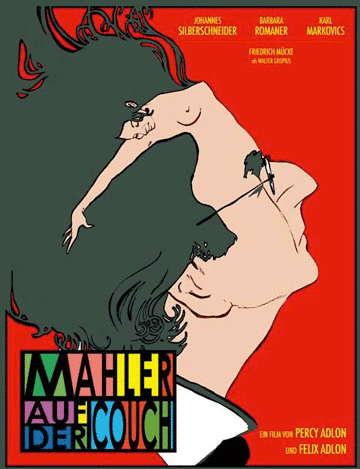
mahler_poster


This fascinating film explored Mahler's marital drama which resulted in his 1910 session with psychoanalysist Sigmund Freud. Of course, the sound track was to die for (from his 4th, 5th and 10th symphonies).  I learned a few things about Mahler from this film.  For example, I guess I should be embarrassed to admit that I didn't realize that during his lifetime, Mahler was better known for his conducting than for his composing! 

As soon as I returned home from the movie I began researching Mahler's wife Alma and Mahler's famous meeting with Freud.  There's really not much known about the details of that meeting, aside from a few clues from Alma.  We do know that Mahler's childhood was quite tragic, and it's safe to assume that this was discussed.  Mahler's parents bore 12 children, yet only 6 survived beyond infancy, and Mahler's favorite sibling, a younger brother, died in Mahler's arms at age 13.  His parents fought bitterly and brutally.  During one of their fights, young Gustav Mahler ran out into the street where he came upon an organ grinder playing merrily.  This juxtaposition of emotions is key to understanding Mahler's music.

If you live anywhere near Columbus, Ohio, by all means come and hear this weekend's performances of the incomparable Das Lied von der Erde conducted by our Music Director Jean-Marie Zeitouni and featuring two out-of-this-world soloists: Sasha Cooke, mezzo and Anthony Dean Griffey, tenor.  (We rehearsed with the soloists this morning and were absolutely blown away by them!)


Masterworks 8:

Song of the Earth

2012-13 Masterworks Series
Lead by CSO Music Director Jean-Marie Zeitouni and featuring guest vocalists Sasha Cooke and Anthony Dean Griffey, this rapturous program includes one of the Romantic era's most definitive compositions, Tchaikovsky's moving String Serenade, written as an homage to Mozart, and concludes with Cortese's orchestration of Mahler's infinitely ingenious combination of song cycle and symphony, The Song of the Earth.
Jean-Marie Zeitouni, conductor
Sasha Cooke, mezzo
Anthony Dean Griffey, tenor
Program:
TCHAIKOVSKY Serenade in C Major for Strings
MAHLER/CORTESE Das Lied von der Erde ("The Song of the Earth")
Song of the Earth
Venue: Ohio Theatre
Friday
Feb. 22, 2013 - 8 pm


Saturday
Feb. 23, 2013 - 8 pm
Masterworks Series Sponsor:

Get tickets to this weekend's concerts for just $15! Just use the code EARTH when you order through Ticketmaster.com or the CAPA Ticket Center (39 E. State Street/ 614.228.8600).


.

Thursday, February 14, 2013

Minute to Win It (bassoon-specific audition tips)

About imageA couple of years ago there was a TV show entitled Minute to Win It in which contestants were given 60 seconds to perform ridiculous, outrageous feats for the chance to win a million dollars.  Maybe the concept is not all that different from what we bassoonists go through to win auditions......certainly most audition candidates are given a bit more than one minute to prove themselves, but not much more.  Most candidates do not advance beyond the preliminary round, which often lasts just a few short minutes for each candidate (after countless hours of preparation!).

My former teacher K. David Van Hoesen told me recently that "back in the day", orchestral auditions were very different from the way they are now.  Bassoonists were invited to play for the conductor and maybe a couple of orchestra members.  In stark contrast to today's staggeringly lengthy audition repertoire lists, there was NO list of required repertoire.  There was no official announcement of job openings - auditions were held by invitation only, so anyone who wanted a job had to be already known.  The candidate would show up in a hotel room or at a hall and play whatever the conductor asked for from memory.  That's right - there was no printed music.  And there were no restrictions on what the conductor might ask to hear.

These days, orchestras must figure out ways to handle very large numbers of audition candidates. It's not unusual for auditionees to be sent to a large mass warm-up room upon arrival at the audition site.  It can be baffling, especially for stressed-out auditionees, to figure out the best possible use of time in that situation.  It might be difficult to hear oneself because of the number of bassoonists playing, yet it can also be daunting to expose oneself in front of competitors if there happens to be a moment in which the others stop playing.  Unless you have a very clear mission to accomplish in the mass warm-up room (such as running through your usual warm-up routine, or testing reeds) then it might be best to just sit calmly in (or outside of) the room.

Next, each candidate may be offered 10 minutes in a private room, at which time the excerpts to be performed will be identified.  At this point there is a fork in the road.  If you plan to use your own music, then you must spend/waste valuable minutes frantically sorting through pages and pages of repertoire to get to the required material, and you may even have to mark the specific measures in your part.  If, on the other hand, you have chosen to use the orchestra's provided parts which will be set up on stage, then all you have to do is briefly and efficiently prepare yourself for each excerpt to be performed.  For example, if the Marriage of Figaro Overture is one of the excerpts to be heard, maybe you'd calmly, quietly and slowly play the first few measures.  The real preparation has been completed by now, so you are just offering yourself brief reminders.

Chances are, you have memorized each excerpt, and it's possible that you typically play those excerpts with your eyes closed.  Why, then, do so many of us insist upon using our own parts during auditions?  For those who are particularly visually oriented, it may be disconcerting to see a different edition on the stand at an audition.  If you are that way, then it makes sense to use your own music.  The fact of the matter is that during the audition, most of us probably do look at the music, even for memorized excerpts.  Try to figure out in advance if  you will come undone at the sight of a part which is laid out differently from the one you are accustomed to.  Have you ever practiced at home using your own part and then used a visually different part during rehearsals?  Did that faze you?  Make your decision for auditions based upon your tendency.

When you are summoned to go onstage, if you have elected to use your own parts, you must juggle your music along with your reeds, water, bassoon and seat strap.  If you are nervous enough, there is a chance of dropping/dumping at least one of those items, and hopefully it won't be the bassoon.

One you have arrived at your chair onstage, each second matters.  Speaking from the perspective of an audition committee member, I can say that the committees are sometimes bored and tired.  It's not easy to remain alert for hours on end to fairly evaluate potential new orchestra members.  Because of that, it's advisable to move at a reasonable pace rather than taking too much time.  But don't rush yourself through your excerpts!  It can be challenging to find the right pacing, and that's where experience (auditioning experience) can prove to be valuable.  It's not unusual to hear about musicians who took 50 or 60 auditions before finally winning.  (Imagine the cost of taking that many auditions!)

Should you play a few warm up notes or not?  The answer is that you must decide well in advance.  Some audition winners do not play any warm-up notes before beginning their excepts, and some do.  If  you decide that you will, then by all means PLAN your warm up, make sure it sounds good, and do not stray from that plan.  

If you are planning to switch reeds at any point, have the reeds ready (soaked and wrapped in damp paper towel, for example).  Of course, it's ideal to use the same reed for each excerpt, but here's one example of how playing an audition is very different from actually doing the job.  On the job, for example, I would definitely have a special reed (one with a 100% reliable low E) for the opening of Tchaikowsky Symphony No. 6.  And I'd have a high reed for the Rite of Spring.  Reed needs vary from player to player depending upon reed style and the characteristics of the specific bassoon, but for me, specialized reeds for high or low solos are best.  Yet I will be the first to admit that for an audition, it's somewhat preferable NOT to switch reeds, since switching is risky and time-consuming.

And what about the perennial question of  whether or not to take a beta blocker such as Inderal?  Many musicians believe that usage of Inderal in small dosages can reduce the anxiety associated with taking an audition.  Nervousness will still be present, but anxiety will potentially be reduced.  Some musicians report a decline in the emotional aspect of their playing while on Inderal - that may be a stiff price to pay for the reduction of anxiety, and that's why each individual must decide for him/herself.

I do believe that anyone taking an audition would benefit from some sort of stress reduction technique.   Deep breathing is particularly beneficial to wind players because our breathing is constricted by nervousness.  There are many deep breathing exercises which may benefit us, such as the one presented in this video:


As bassoonists, we have additional worries associated with air travel.  Many of us, myself included, have experienced the nightmare of being told upon boarding an aircraft that we may not carry on our bassoons.  This problem is more common these days with many flights being booked to capacity, thus reducing the amount of available overhead storage space available to each passenger.

There are ways to reduce your chances of being stopped from carrying on your bassoon.  If you're lucky enough to be flying on Southwest Airlines, you have the option of paying a nominal additional fee for early boarding.  That ensures that you will gain access to overhead space.  On other airlines there may also be ways to ensure earlier boarding.  On Delta, for example, some flights offer Priority Boarding for a fee, which ensures access to overhead storage. 

Be sure to check on the size of the aircraft before you purchase a ticket.  Smaller planes do not allow ANY carry-ons!  Also, limit your carry-on to your bassoon - if you attempt to carry on another item as well, you are reducing your chances of carrying on the bassoon.  This probably  means you will pay a fee to check a bag, but all of these extra fees pale by comparison to the price you'd likely pay, monetarily and otherwise, as a result of your bassoon being placed in cargo!

There is one very  important factor which we bassoonists must consider which other musicians don't have to worry about for auditions.  If you are traveling to another area for the audition, which is nearly always the case, then your reeds will be different at the audition site.  It's best if your schedule allows enough time to arrive in the audition city with adequate time before the audition to test and adjust  your reeds.

Of  course, this leads to the next problem we bassoonists face.  If you fly to your audition, don't try to carry on your reed-making tools!   The TSA does allow sheathed knives in checked baggage.  However, the TSA warns that "It’s important to know that even if an item is generally permitted, it may be subject to additional screening or not allowed through the checkpoint if it triggers an alarm during the screening process, appears to have been tampered with, or poses other security concerns. The final decision rests with TSA on whether to allow any items on the plane."  In other words, there's no guarantee that your reed knife will make it through the screening process.

There are many valuable books written about how to ace an audition, and there are numerous successful  audition coaches offering their services. (Don Greene is one of the best-known.)  But bassoonists face extra challenges well beyond the norm of an already overwhelmingly stressful undertaking!

Good luck to each of you who face future auditions.  In spite of everything brought up in this post, somebody will win the audition.  It may as well be you!


.

Sunday, November 25, 2012

Stravinsky Octet for Wind Instruments

Igor Stravinsky (1862-1971) wrote his Octet in 1922-3 during his early Neo-Classical period.  At this stage of his career he was abandoning his "Russian phase" which had brought us such works as The Rite of Spring and The Firebird.  His Neo-Classical.works (which never caught on with audiences to the degree that his Russian phase works had) combined a formal, structured compositional style with modern sounding harmonies, rhythms and counterpoint.  (His third and final phase of composition was his serial period, in case you're wondering.)

Stravinsky himself conducted the 1923 premier of the Octet at the Paris Opera House, since he had disliked Serge Koussevitsky's conducting of the premier his earlier work Symphonies of Wind Instruments.

Paris Opera House where Stravinsky premiered his Octet
Apparently Stravinsky stated that "there is no interpretation" for the Octet, and that's part of the reason he insisted on conducting it himself (so that it wouldn't be ruined by a conductor's interpretation of a piece which requires no interpretation!).  What he meant by that, I think, is that he had been so clear in his markings (including metronome markings) that all that was necessary was for the performers to follow his instructions.  Here is a recording (divided into 2 parts) of Stravinsky conducting the Octet:


It's unusual for bassoonists to have the opportunity to perform the octet on an orchestral subscription series, but luckily for me, the Stravinsky Octet was programmed on a Columbus Symphony classical subscription series.  As you may know, this piece is sometimes performed without conductor, but seeing as how Stravinsky himself conducted the Octet numerous times, it seems judicious to follow his example and use a conductor.  Here in Columbus our associate conductor Peter Stafford Wilson conducted our performances.

The octet is scored for 2 trumpets, 2 trombones, 2 bassoons, one flute and one clarinet......where did the odd instrumentation come from?  This is what Stravinsky told his biographer Robert Craft:

The Octuor began with a dream in which I saw myself in a small
room surrounded by a small group of instrumentalists playing some very
attractive music. I did not recognize the music, though I strained to hear it,
and I could not recall any feature of it the next day, but I do remember my
curiosity—in the dream—to know how many the musicians were. I
remember too that after I had counted them to the number eight, I looked
again and saw that they were playing bassoons, trombones, trumpets, a
flute and a clarinet. I awoke from this little concert in a state of great
delight and anticipation and the next morning began to compose the
Octuor, which I had had no thought of the day before, though for some
time I had wanted to write an ensemble piece—not incidental music like
Histoire du Soldat, but an instrumental sonata.
There are plenty of bassoon-related challenges in the Octet.  The opening Lento calls for some tricky trills, such as the high Aflat to Bflat at the beginning:


 This is the fingering I found to work best (as you can see above, I wrote the fingering in the part because I was not familiar with it):


This trill is certainly awkward, though, and is not the most comfortable way to begin a piece.  With both the right and left hands involved in trilling, coordination is tricky.  Don't be surprised if your bassoon shakes, as if the entire instrument must participate in the execution of this dastardly trill.  

As you can see in the following excerpt from page 2, the bassoon is often called upon to play staccato in Stravinsky's works. If the notes don't have dots, then the abbreviation "stacc." may appear underneath the staff.  Typically, the "Stravinsky staccato" is ULTRA short, and it certainly seems that Stravinsky capitalized on the bassoon's ability to play staccatissimo.


The passage which most musicians, bassoonists or otherwise, associate with the Octet's bassoon parts is the repeating 32nd note scale passages as demonstrated in Variation A below: (especially the downward scales beginning in the 4th measure):


The second bassoon continues the downward scales so that the 32nds sound continuous.  Even though this is what most listeners seem to notice, this is certainly not the most difficult aspect of the 1st bassoon part.

The following 5 measures leading into and beginning Variation C are even more challenging than the above scales:


Fortunately, our maestro conducted the measures before Variation C in quarters.  I spent considerable time practicing (with metronome) dividing the beat into 7 parts and into 5 parts so that I became comfortable with the relationship between the septuplet and the quintuplets. I didn't bother with the notes at first - I either just played on a single note or just used my voice.  (Rhythm is such an important aspect of music that it deserves to be practiced separately from the notes!)

Then at 33 (variation C) the tempo suddenly changes, and it's in one, AND the fingerings become treacherous at that point as well.  In fact, I made up a fingering for A# to B as an alternative to the standard fingerings.  I fingered A# as usual, then for the B, I added the B flat key while lifting the 3rd finger left hand.  That fingering combination, while somewhat more reliable than the standard fingerings, was still nerve-racking.  Despite that observation, I do recommend that fingering since I don't know of any better way to execute that passage.

Variation D is fast (quarter = 160) and light.  


The 16ths at 42 are fast, but playable after slow practice.

The low A, such as the one at 40 below, is suddenly loud and accented, and that happens repeatedly. (This is from Variation D pictured above.)  Due to the sudden dynamic change as well as the pitch tendency of the note, the low A is likely to be sharp in pitch if the player does not make an embouchure adjustment.  (The lower jaw should suddenly drop to lower the pitch.)


The 3rd movement (Finale) begins with a rather martial-sounding 1st bassoon solo accompanied by the 2nd bassoon. Especially for a bassoon solo, it's really long, lasting from the bridge at the end of the 2nd movement to #61, and should be played with lots of character.  Sometimes  bassoonists tend to automatically play at a healthy mf dynamic for any passage marked "solo", but watch out - this solo is marked "sempre p e stacc."!  It should be kept strictly in tempo, and short, light, and quiet.


As with so many Stravinsky bassoon parts, there is indeed a passage in the extreme high range.  It can be seen above beginning 8 bars after 61.  Because of that, it is necessary to use a reed which reliably hits high D.

At 66 begins a lengthy passage of continuous notes with no break.  I think it is important for bassoonists to learn to take very, very quick breaths for such situations.  The breaths should be so short that no time is lost and there is no interruption in the part.  If the staccatos are as short as Stravinsky intended them to be, then such quick snatch breaths are indeed possible.


I think it's a great idea for symphony orchestras to offer chamber works such as this one now and then.  The audience benefits from seeing and hearing the wind instruments up close, and the players get to enjoy the opportunity to perform chamber music for larger audiences - a win-win!


.

Monday, October 15, 2012

Baroque masterpiece for orchestra (with a great bassoon part)

Jean-Féry Rebel (1666~1747) was a child prodigy violinist who studied composition with Jean-Baptiste Lully and served as court composer for Louis XIV.  At age 71 he came out of retirement to produce a shocking ballet, Les Élémens, in which he set out to depict the settling of creation into its natural order.

Rebel wrote of the work :“I have dared to link the idea of confusion of the Elements with that of confusion in Harmony. I have risked opening with all the notes sounding together, or rather, all the notes in an octave played as a single sound”.  Yes, he really does begin the piece with dissonance - the first "tone cluster" in the history of music!  The man was indeed a rebel.

Although the original score is lost, fortunately the parts (or some of the parts) were preserved.  The bassoon part, assuming it's original, was written for a virtuoso, as evidenced by the following passage in the Chaconne, in cut time:


This reminds me of an intriguing fact I read recently.  Apparently double-tonguing used to be common on the bassoon in bygone eras, which explains some rapid tongued bassoon passages written by Handel, Vivaldi and of course Beethoven.  In more recent times, at least over the past century, double tonguing on the bassoon fell out of favor, possibly due to the fact that oftentimes it doesn't sound very good due to the presence of the reed in the mouth.  During the past 20 years or so, however, double tonguing has again become an important aspect of bassoon technique, fortunately for any bassoonist performing Les Élémens.

There is also a movement featuring the bassoon as soloist: 


Here's a performance of the entire work, with a dancer:


If you live anywhere near Columbus, Ohio, please do come to hear the Columbus Symphony with Music Director Jean-Marie Zeitouni perform this piece live on Friday, Saturday or Sunday in the Southern Theatre.  Here are the program details and ticket-buying links:.


Masterworks 2:

In Nature's Realm

2012-13 Masterworks Series
Jean-Marie Zeitouni guides you through Beethoven's enchanting landscapes of the countryside in the refreshing Pastoral Symphony. Even though written in the 1700's, Jean-Frey Rebel's surprisingly contemporary tone poem Les élémens (the elements), depicts the creation of the world and all its creatures. The program is completed by Rossini's William Tell Overture painting a musical picture of a Swiss Alps dawn, storm, pastoral calm, and the famous cavalry charge gallop.
Jean-Marie Zeitouni, conductor
Program:
ROSSINI Overture to Guillaume Tell (William Tell)
REBEL Les élémens
BEETHOVEN Symphony No. 6 in F Major, Op. 68, Pastoral
Russian Soul
Venue: Southern Theatre
Friday
Oct. 19, 2012 - 8 pm


Satuday
Oct. 20, 2012 - 8 pm
Sunday
Oct. 21, 2012 - 3 pm

Masterworks Series Sponsor:

Monday, September 24, 2012

The Cleveland Orchestra bassoon section's newest member

In case you haven't heard the news, Billy Hestand is the winner of today's audition for second bassoon of The Cleveland Orchestra!

Photo

I had the good fortune to hear Billy play through the audition material a couple of days ago when he stopped in Columbus on his way to the Cleveland audition.  What a thrill it was to hear a bassoonist who was on the verge of winning a position in one of the world's greatest orchestras.  Clearly, he played like a winner.  He had what I would describe as the Cleveland sound - very beautiful and refined - never out of control or the slightest bit crass.  The beginnings and releases of his notes were subtle and perfectly controlled.  He found the right character for each excerpt, showing total command of the orchestral repertoire.  He was ultra prepared, calm and confident.

That's what a winner sounds like.  Congratulations, Billy!

Friday, August 31, 2012

Orchestral Baroque ornamentation

It's easy for a symphony musician to feel a bit like a fish out of water when performing Baroque repertoire. It's not unheard of for the training of classical musicians to include no Baroque performance practice whatsoever.  Sure, most of us have listened to Baroque recordings, but oftentimes contemporary performance practice is applied to Baroque repertoire.

The Columbus Symphony has performed a number of Baroque works recently with our Music Director Jean-Marie Zeitouni in which we did actually follow Baroque performance practice.  (If you'd like to hear an example, InstantEncore is streaming our  Best of Baroque concert.)  But I haven't had enough experience in the Baroque realm to be able to state that I'm comfortable with it yet.

Earlier this month I had the opportunity to perform with another orchestra.  One of the featured works was the Vivaldi Concerto for Flute, Oboe and Bassoon "La Tempesta di Mare" RV 570.  The first movement is featured in this video by La Orquesta Sinfonica "Kronos":


None of the recordings I found of this work had much, if any, ornamentation going on in the solo bassoon part, so at first I was planning to just play the printed notes.  But I have always been fascinated by Baroque ornamentation.  When I closely examined the bassoon part it appeared as though someone had penciled in some ornamentation which had been erased.  At first I ignored it, but eventually I became obsessed with the notion of adding ornamentation to my part.

I found a couple of YouTube videos of the piece which were pitched at A=440, and I played along.  I really liked adding ornamentation, and practiced doing so.  At first I used the faint traces of ornamentation which had been erased from my part, and using those markings as examples, I came up with some fairly elaborate ideas.  There wasn't enough room on the part to write out those elaborate ideas, so I wasn't sure what to do?  Should I write out a whole new part? Should I even be trying to plan the ornaments before I knew the tempos?  Or should I just "wing it"?

And how exactly does one "wing it" anyway?   How do we learn how to improvise ornamentation?  The only way I know of is to listen to examples.  When I was a student at Eastman I spent many an hour in the music listening library learning how to be a musician.  I was mesmerized by a recording of oboist Leon Goosens playing the Bach Arioso BVW 1056.  It included ornamentation which is forever embedded in my brain.

It's easy to find examples of Baroque ornamentation on YouTube.  Here's a gorgeous example by German oboe virtuoso Burkhard Glaetzner:


On the day of the first rehearsal of the Vivaldi Concerto for Flute, Oboe and Bassoon "La Tempesta di Mare" I had still not figured out what I was going to do......I wanted to use ornamentation, but fully expected that the conductor would put the keibash on that.  After all, I have never before used ornamentation in the orchestra.  I had other things to worry about anyway, such as whether I would double-tongue or single-tongue the many consecutive 16ths.

During the initial read-through of the first movement, I was a complete and utter coward.   I played it straight, without a single added note.  Luckily for me, we went back and read it again.  This time emboldened, I found myself adding notes and flourishes here and there which seemed to fit, kind of playing it by ear.

When we finished that run-through, I braced myself for the conductor to ask what on earth was going on with the bassoon.  To my complete surprise, he exclaimed that he loved the ornamentation in the bassoon!

The tempo was faster during the performance, which is one of the reasons why it's so exciting to be an orchestral musician.  (I mean that!  I love the thrill of having to adjust at the last minute as the conductor and musicians find themselves caught up in the moment.)  This meant that I had to switch to double-tonguing and it also meant that the ornamentation was different from what I had in mind.  It was a thrilling performance, the type that reminds us of why we chose to be musicians.


Share


.

Tuesday, May 22, 2012

A highly recommended new composition for bassoon & string trio


My Columbus Symphony colleague violist Brett Allen recently wrote a blog post about his new composition for violin, viola, cello and bassoon.  Brett and I have already performed it with Quartet Amici here in Columbus.  It was challenging for each instrument, but the piece is a lot of fun to put together and is extremely appealing to the audience.

Here's Brett's explanation of his new piece, 4amici:

4amici: Quartet for Violin, Viola, Cello & Bassoon

As unusual as the quartet combination of Bassoon, Violin, Viola and Cello may be, there does exist an ample body of repertoire for it. Out of the Classical period composers Franz Anton PfeifferJohann Christoph Vogel, Francois Devienne, and Franz Danzi all wrote for the combination. Though not household names like Mozart or Haydn, their output remains significant today for both showcasing the bassoon and tracing the development of bassoon technique.

In more recent times, and in like manner, composers Villa-Lobos and Vaughn Williams have works setting solo bassoon against a bed of strings, though not the exact combination under discussion. But, Bernard Garfield, long-time Principal Bassoonist of the Philadelphia Orchestra, now retired, has no less than three Quartets for Bassoon, Violin, Viola and Cello in his catalog, in addition to reams of other bassoon-centric chamber works.

When Betsy Sturdevant, Principal Bassoonist with the Columbus Symphony, invited me to play and compose for her Amici Quartet, I saw it as an opportunity to break the bassoon-showcase mold in some respects. I thought, "Bassoon, plus Violin, Viola and Cello. How likely is that? It sounds like a wedding gig where the 2nd Violinist became indisposed and the other quartet members went out and grabbed the first instrumentalist to come along - a bassoonist!" Such suspension of disbelief is possible only in music videos, but I retained the idea of this being some kind of pick-up group.    

That, plus I had just seen the movie, The Visitor. I won't give the plot away except to say that a burned out college professor gets hooked on hand drumming and starts showing up at community drum circles. The phenomena of drum circles is of huge interest to me because it is quite the opposite of my classical, tightly structured training in music. What I am saying is - it explodes my whole musical universe! No one brings music. No one comes "prepared." It doesn't matter how "good" you are. No one knows what's going to happen. There's no leader. It's entirely spontaneous. As the drumming rises in intensity, people start dancing and singing. All the while new and interesting drumming patterns are rising to the surface. There's no distinction between audience and performers. No one "performance" can be written down or recreated. No one owns it. No one says, "I invented this, I am a great genius." It seems to reach down deep in the human soul and call forth some primitive, essential need to express. Everyone goes away quite satisfied, the same as if they had just listened to Beethoven's 9th Symphony.

I went to work on my "4amici" quartet with all these things in mind. I had a vision, like a stage play. Four buddies (four friends, "quattro amici"), wandering about the city, decide to gather in a public spot for a jam session. In this vision each instrumentalist is an equal participant, it's not just the bassoon on display. Each one throws in a musical idea. One is thinking about half-steps. Another throws in a forceful downward third. Another takes that and turns it on its head. Before long some semblance of music takes shape. Suddenly, there is an interruption, ceremonial music, as if the mayor is passing by. Later, the same material is transformed into something that sounds like a war song from the old country. Then the strings decide to cut the bassoon out and do their own thing. But the bassoonist won't have it and crashes the party. And so it goes, on and on. Each section spins out new ideas and new sections. Where it is headed and where it ends is anyone's guess. Eventually though, as with drum circles, the high energy dissipates and everyone calls it a night.

Sample parts are available on Scribd.com. Sheet Music is available for purchase here.

Thank you, Brett, for this most welcome addition to the bassoonist's chamber music repertoire.