bassoon blog

musings of a professional bassoonist

Monday, May 13, 2013

Marching metronomes


I'm not even sure of what to say about this other than to observe that this is a video of 32 metronomes placed on a flexible surface.  Each metronome is turned on, and multiple tempos conflict.  But after a couple of minutes of magical adjustment, the metronomes end up perfectly synchronized. Even the unusually defiant red metronome in the far right row, second from the front, ends up giving in at around 2'40''.

This would not happen if the metronomes were placed on a solid surface, because the communication among the metronomes requires a flexible medium.

Flexibility is the name of the game.... in life, in music, and in magical marching metronomes.


.

Tuesday, April 9, 2013

WHY we do what we do


This coming week the Columbus Symphony is performing a series of Young People's Concerts on weekday mornings for public school students.  These students, some of whom have never heard an orchestra before, will play a part in determining our future (or lack thereof).  It is essential for an orchestra to be clear about its reasons for existence, and to be able to communicate that to its supporters, both future and current.

The following TED video explains what I mean by that:


Simon Sinek shows that great leaders and organizations (including orchestras) inspire.  People don't buy (or support) what you do - they buy why you do it.

A few years ago Sinek discovered that there is a pattern in the way that great leaders and organizations think, act and communicate, and it's the complete opposite of the way everyone else does it.  To illustrate his point he uses the "golden circle" which contains the words why, how and what:


Every organization on earth knows "what" it does, and some know "how" they do it.  But few know "why".

Making profit is not the "why", since making profit is a result.  The "why" is about the following:
  • What is your purpose?
  • What is your cause?
  • What is your belief?
  • Why does your organization exist?
  • Why do you get out of bed in the morning?
  • And why should anyone else care?
Getting back to the golden circle, most leaders or organizations think, act and communicate from the outside in, from the clearest (the "what") to the fuzziest (the "why").

But inspired organizations, regardless of size or industry, all think, act and communicate from the inside out. They begin with the "why".

Sinek uses Apple as an example.  If Apple followed common market strategy, their message would be: "We make great computers.(the "what")  They're beautifully designed, simple to use and user-friendly.(the "how")  Do you want to buy one?"

Instead, Apple markets this way."We believe in challenging the status quo.(the "why")  We believe in thinking differently.(the "why")  The way we challenge the status quo is by making our products beautifully designed, simple to use and user-friendly.(the "how")  We just happen to make great computers.(the "what")  Do you want to buy one?"

Apple reverses the order of the information, beginning with (and emphasizing) its "why".  Apple thinks, acts and communicates from the inside out. 

People don't buy what you do - they buy why you do it, because they believe what you believe.

A fascinating aspect of Sinek's concept is that it's grounded in the tenants of biology.  If you look at a cross section of the human brain, its three main sections correspond to the golden circle.  The outer section, the most recently evolved part of the brain, is known as the neo cortex.  It is the site of rational and analytical thought and language.  It corresponds to the "what" of the golden circle.  The more ancient brain is made up of the reptilian brain and limbic system. This is the emotional part of the brain, the source of feelings (including loyalty and trust), behavior and decisions, and it corresponds to the "why" of the golden circle.  When an organization communicates with that part of the brain, using the "why", it is in contact with the part of the brain which controls behavior and decisions. 


A symphony orchestra's mission statement offers a clue as to whether the orchestra is inspired, like Apple, or whether it's struggling like so many other orchestras.  I found the following mission statement on the internet for an orchestra whose identity will remain concealed:
The ABC Symphony's mission is to advance a symphony orchestra of the highest artistic standard for the enrichment and well-being of the area. This mission is achieved through a strong connection to the community, and in-depth understanding of the marketplace and a commitment to providing programming that meets the needs and desires of the community. The ABC Symphony performs a diverse array of classical, pops, family and educational concerts each season, reaching an estimated 500,000 people through live performances and radio broadcasts.
ABC  Symphony clearly understands its "what" and even its "how".  What's completely missing is its "why".  I'm willing to bet that ABC Symphony has difficulty attracting the donations it needs to sustain itself.

Perhaps it would be possible to reset its mission (and its level of success) if ABC Symphony asked itself the following questions:
  • What is your purpose?
  • What is your cause?
  • What is your belief?
  • Why does your organization exist?
  • Why do you get out of bed in the morning?
  • And why should anyone else care?
Ideally, those questions would be asked of the board, management and musicians.  And the answers would determine the orchestra's future, because if the orchestra doesn't know why it exists, it's going to be very difficult for that orchestra to inspire support.

Imagine this mission statement:
The ABC Symphony believes in the power of classical music to transform lives.  We present classical, pops, educational and family concerts, in various venues and media, so that our music is able to touch each and every life in ABC City and its environs.
 I'd donate to that orchestra, because I, too, believe in the power of classical music to transform lives!  How about you?


.


Saturday, April 6, 2013

Bach off, buster!


How to Handel loiterers? 

Give ’em a blast of the 

CLASSICS


graphic from The Columbus Dispatch

According to a recent article in The Columbus Dispatch, some people view classical music as a deterrent to crime.  We've all read reports of classical music being blasted outside of subway entrances and convenience stores, with the apparent result of reduced loitering and the prevalence of peace.

Does this mean that classical music repels, rather than attracts, people?  NOOO!  That notion is absurd, seeing as how the convenience stores certainly do not wish to get rid of paying customers with their classical serenades.

The Dispatch article referred to classical music being played outside of the YMCA in downtown Columbus, where apparently there have been problems with loiterers.  I just happened to be walking past that YMCA yesterday, and I heard a rather rousing rendition of Eine Kleine Natchmusik being broadcast.  If the goal was to stop loitering, it was failing.  There were several men, very possible residents of the Y, standing around talking.  They weren't fighting or arguing or behaving in a menacing manner - they were holding a quiet conversation.  As far as I could tell, the music had a calming and beneficial effect.  If the goal was to restore peace, it was working.

In 2004, the British Transport Police piped classical music into the London Underground to see if the crime rate would be affected.  The result was that robberies decreased 33%, staff assaults decreased 25% and vandalism decreased 37%.  There have been similar reductions in crime elsewhere following the deployment of classical music in crime-ridden areas.

There have been studies conducted at numerous universities examining the use of different types of music to reduce stress.  The British Journal of Health Psychology reports that researcher Sky Chafin at the University of California, San Diego tested the effects of jazz, pop and classical music in reducing blood pressure following incidents which caused high levels of stress.  The participants listening to classical music recovered much more quickly than those listening to jazz, pop, or silence. 

Yes indeed, classical music has a measurably soothing effect, even on hardened criminals.

So do classical musicians have reason to become upset upon hearing that their music is being used as a crime deterrent?  Hardly!  I think we should be flattered.  Before we know it, symphony orchestras will be forming partnerships with their local police departments. 

Just think of the endless examples of classical music being used to sell products on TV.  In this example, the Verdi Requiem was used to sell Doritos during the 2011 Super Bowl:


.
Frito-Lay doesn't consider classical music a repellent!  So, classical musicians, stop worrying about your music being used as a repellent, and rejoice in its powers to soothe and to sell!

.

Wednesday, April 3, 2013

Looking for a Summer Festival?


Here's one to check out! The Philadelphia International Music Festival (PIMF) offers a series of classical music programming to students of all ages and skill levels in the United States and around the world, creating the unique opportunity of spending fourteen days immersed in music education and performance with members of the esteemed Philadelphia Orchestra.

PIMF includes four program options: orchestral studies, solo performance studies, college audition preparation, and piano studies for pre-college students (information available at www.PhiladelphiaMusicFestival.org/about), as well as a separate program for college students and young professionals (information available at: www.PhiladelphiaMusicFestival.org/musichouse). All programs include private lessons and master classes with members of The Philadelphia Orchestra (including principal players), solo performance and competition opportunities, chamber music, daily private practice, optional daily music study courses, faculty recitals featuring principal players from The Philadelphia Orchestra, and more. Contact their office for further details at: 856.875.6816

There are still openings for students of all ages and skill levels!


music camp, music camps, summer music camp, summer music camps, orchestra camp, orchestra camps, summer orchestra camp, summer orchestra camps, band camp,band camps, summer band camp, summer band camps


.

Saturday, March 30, 2013

The Rite of Spring

The premiere of Stravinsky's The Rite of Spring Ballet at the Théâtre des Champs-Élysées in Paris on May 29, 1913 went down in history for inducing a riot.  The audience that night was expecting conventionally elegant ballet, not pagan rituals leading to the sacrifice of a young girl who dances herself to death.  The noise, fighting, and shouting in the audience rose to such a volume that the great choreographer Nijinsky had to shout out the numbers to the dancers so that they knew what they were supposed to do.  Pandemonium prevailed.

part of the set for the Ballet Russes 1913 production of The Rite of Spring

We bassoonists like to think that it was Stravinsky's music - especially his outrageously stratospheric  opening bassoon solo - which inspired such bad behavior from the audience.  Apparently, that's not entirely true, and in fact the audience noise drowned out the music during much of the performance.  According to reports, the attendees were more upset by the barbaric choreography, the Russian pagan set designs and the primitive costumes.

In all fairness, though, the opening bassoon solos really did cause some uneasiness, especially for the intrepid individual playing it for the first time ever.........


The opening bassoon solo is still mighty daunting, even now that it's been played for a full century with varying degrees of success.  (I once heard about a well-known bassoonist who received a scathing review for the Rite of Spring in the next morning's newspaper.)

When I was a student at Eastman I read a quote from Jascha Heifetz about performance preparation.  I don't know the exact quote, but the gist of it is that it's necessary to be 200% prepared, not just a mere 100%.  At the time, I didn't fully understand, but I took note of it.

Since then I have come to understand that it is impossible to create true performance conditions at home while practicing.  I know that many audition coaches recommend attempting to do just that, such as by running up and down the stairs a few times before immediately sitting down to play.  However, it has been my experience that nothing compares to playing the solo in the orchestra and in the hall, whether it be for a rehearsal or for a concert.

The possible reasons for this phenomenon are fairly obvious:
  • nervousness or anxiety which is present only on stage
  • the presence of the conductor and other musicians, who must be accommodated with regard to tempo, timing (rubato), intonation, and volume 
  • acoustics of the hall
Last week the Columbus Symphony with Music Director Jean-Marie Zeitouni presented The Rite of Spring in collaboration with BalletMet.  (The orchestra was onstage rather than in the pit.)


During the first rehearsal of The Rite of Spring last week, despite my careful preparation, I was caught by surprise in two ways.  First, even though I am familiar with the hall, I was shocked by the way the opening of the Rite sounded.  I don't often have the opportunity to hear myself alone on stage.  It takes The Rite of Spring for that to happen.  The extreme dryness of the hall caused certain internals to sound to me as though there were huge chasms between the two notes.  The other unexpected factor was that I found that my left thumb was accidentally opening the low D key, which threw off the pitch when it happened.  Why didn't that happen when I was practicing?  My guess is that my fingers were more relaxed during practice, and unlikely to bear down on the low D.  (For those of you who have large hands, this will never be a problem.)

Each of the two problems had a solution.  For the issue with the low D key opening inadvertently, I stuck a foam earplug under the low C and D keys so that they wouldn't open no matter how much pressure I applied.


For the smoothness factor (eliminating "chasms"), I found the following exercises, played with extreme smoothness, to be helpful:


Those exercises are deceptively difficult and I spent a great deal of time with them.  Especially challenging is the interval from E3 (the 3rd E on the bassoon) to B4.  I often isolated that interval.  Also, I turned on my chromatic tuner to check the pitches.  On many bassoons, the G3 tends to be high and the lowest note (E or E flat) tends to be low.  Another helpful variation is to turn on a drone on one of the notes in each exercise.

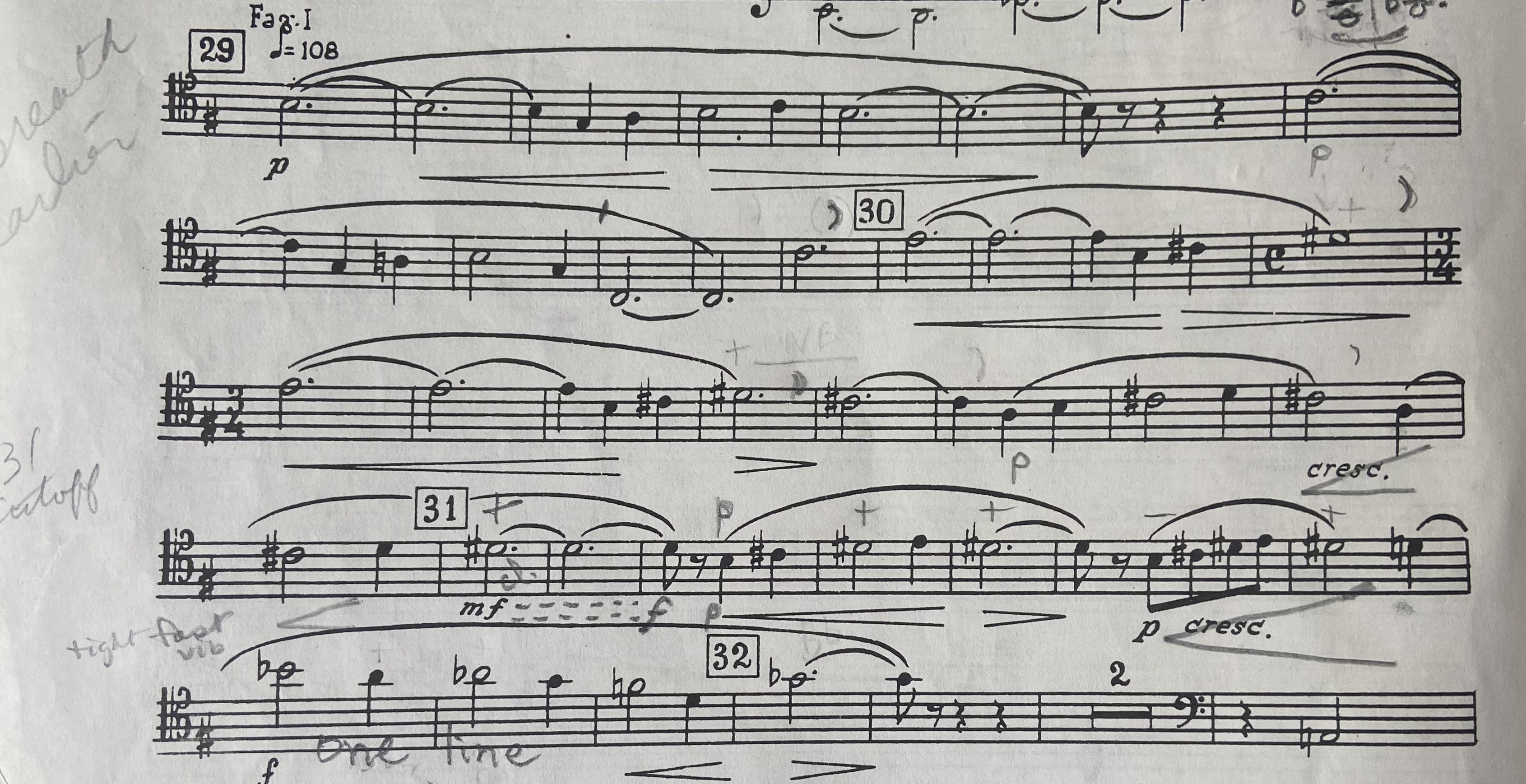
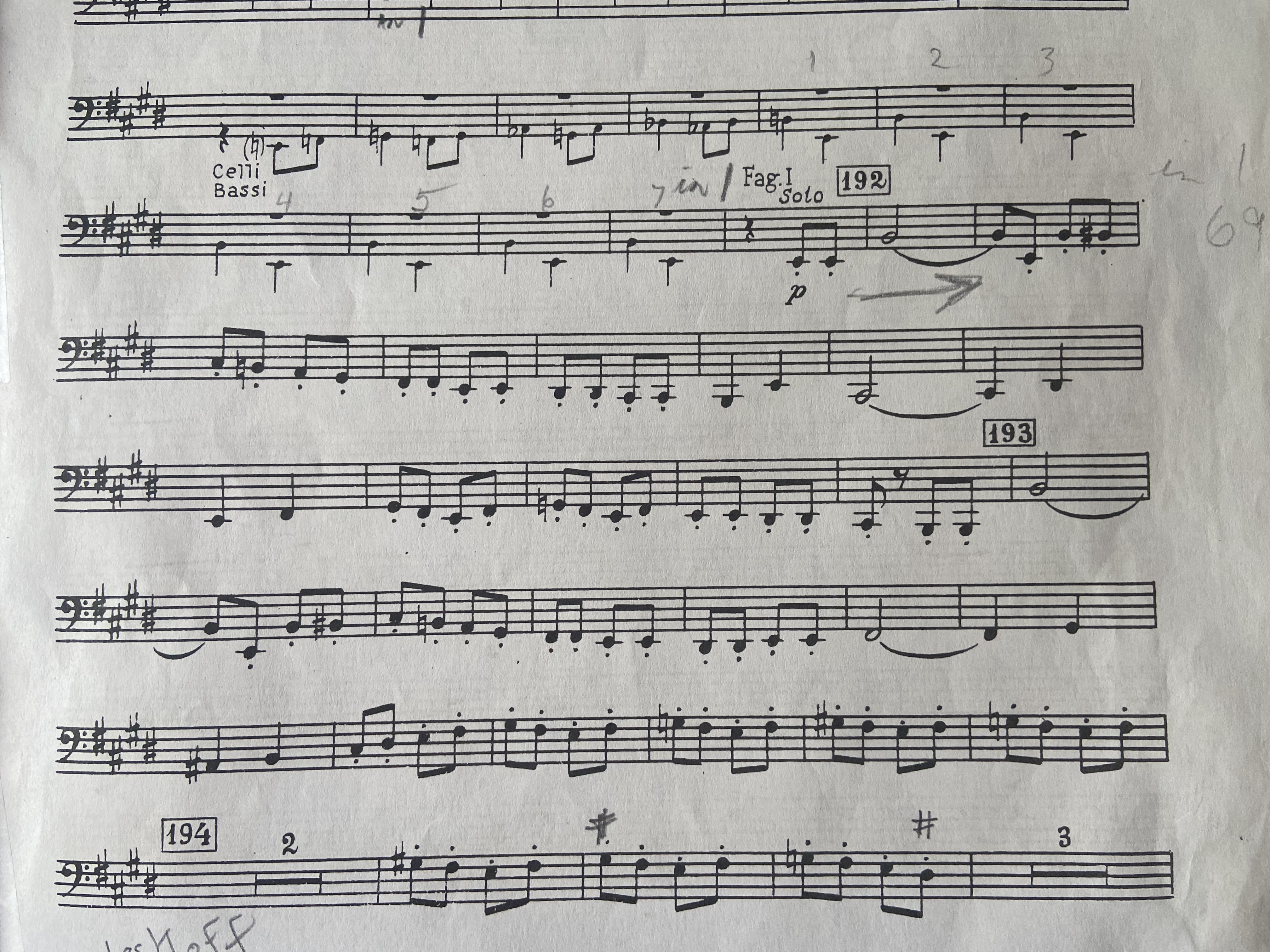
In the above exercises, the grace notes are added in the second line.  They should sound smooth, not standing out in any way and not being slighted.  My teacher K.David Van Hoesen always said they should be melodic - that means not rushed.  Also, those grace notes can create a "squeaking" sensation if they go too fast.  The 2 measures at big number 1 in the opening solo pictured above are especially tricky in that regard.  I found that backing off the grace notes (not putting too much air through the instrument) and not letting them be too quick helped avoid "squeakiness". 

In my opinion, the biggest challenge when playing in the extreme high range of the bassoon is intonation.  My bassoon, for example, has a tendency to play the high C on the sharp side -  higher than the other notes and higher than the 440 standard.  However, my bassoon can be coaxed to play the C down to pitch.  It takes a loosening of the embouchure and a conscious effort to play low.

Thinking of Heifetz's advice to prepare 200%, I did everything I could think of to ensure the proper pitch of high C.  Beginning a few weeks prior to our first rehearsal, I began practicing the opening solo while a loud C at 440 was sustained on my electronic keyboard.  That prevented me from allowing a deviation from 440.  Once in a while I'd turn off the drone and use an electronic tuning meter to force myself to find the right pitch without the aural assistance.  This may seem like a lot of work, but there are some notes on the bassoon which the player can be tricked into playing at the wrong pitch level, and it does take a lot of effort to overcome that.

One of the other problems associated with playing in the high range is simply lack of familiarity.  Practicing extended scales on a regular basis helps, but let's face it - we rarely play solos in the extreme high range.  The reed is critical.  Being one of those bassoonists who prefers to play on new reeds, I tried to make a new reed for The Rite of Spring but did not succeed.  On the newer Heckels like mine it is difficult to begin the high C without a "cacking" noise, and newer reeds have a greater tendency to cack.  I went through hundreds of reeds both old and new before finding the one that I trusted to not cack.  It was an old reed, but I don't think I had ever played on it before, so it wasn't worn out.  Then I had the dilemma of how to practice - I didn't want to wear out my chosen reed, but each reed played differently.  I had a box full of practice reeds which I forced myself to use at home most of the time.

I often record my practicing, and it's safe to say that I made hundreds of recordings of the opening of the Rite over the past few weeks.  Smoothness, sound and intonation issues are easily revealed that way, and to me, it's an integral part of preparation.  

It goes without saying that one's embouchure must be in top form for The Rite of Spring - but not just normal top form.  The embouchure used in the extreme high range is somewhat different from the embouchure needed for the rest of the range.  One must spend a great deal of time in the high range during the weeks leading up to The Rite of Spring.  Long tones in the high range can speed up the embouchure-strengthening process.

Even after all of that, it's still daunting.  Yet it's what we live for, isn't it?  When I began my Rite of Spring preparation routine for the last time on the Sunday of the final performance, I was stricken with sadness that the final performance was about to take place, and then it would be over.........

Photo: Ohio Theatre
L to R: Betsy Sturdevant, Douglas Fisher, Christopher Weait, Jesse Schartz, Cynthia Cioffari

.


Tuesday, March 5, 2013

News flash for air-traveling bassoonists (and oboists)

As of April 13, 2013, double reed players flying with their instruments will be allowed to carry on reed knives, according to this new information from the TSA.

Small knives permitted in carry-on luggage must meet all of the following requirements:
Permitted:
Permitted symbol The blade must be no more than 2.36 inches or 6 cm in length – from tip to where it meets the handle or hilt
Permitted symbol The blade must be no more than ½ inch in width
Thumbnail of PowerpointNot Permitted:
Not Permitted symbol Knives with locking or fixed blades
Not Permitted symbol Knives with molded grips
Not Permitted symbol Razors and box cutters


As you can see, any knives carried on must be of the folding variety.  I have never used a folding knife before, but I know they're fairly common.


One thing that hasn't changed is this last word from the TSA:  "The final decision rests with TSA on whether to allow any items through security checkpoints."  So....don't take your favorite knife!


.

Monday, March 4, 2013

Judging young students

The Columbus Symphony Youth Orchestra Program is one of the best in the nation.  There are no fewer than 6 youth ensembles, ranging from the Junior Strings for students in grades 3-6 to the ultimate ensemble, the Youth Orchestra, which has performed in Europe, in China, and in Banff for the International Youth Orchestra Festival.  The Columbus Symphony's Associate Conductor Peter Stafford Wilson explains the program in this video:


Last week I was asked to judge the woodwind seating auditions for the Cadet Orchestra (for students in grades 7-10). I enjoyed meeting the young musicians and hearing them perform excerpts from their current orchestral repertoire.

My job was to assess the tone, setup/posture, rhythmic accuracy, note accuracy, intonation, articulation, and style/expression for each excerpt.  It was really difficult to focus on so many issues during each 5-minute audition!  What ended up happening was this: I focused on whatever stood out.

And for most of the students, even the ones who obviously were practicing a lot, it was the rhythm. 

Are we, the teachers, spending enough time teaching the importance of rhythm?  I remember being taught by Ryohei Nakagawa how to sight read: he said that the rhythm is top priority, and that if you just make sure the rhythm is right, you'll be on the right track.  His advice served me well during my audition for the Columbus Symphony.  I was asked to sight read Strauss' Death and Transfiguration.  I was rather young at the time, and had never even heard the piece.  I studied the rhythm for a few moments, asked the proctor in a whisper what the tempo should be (fortunately, he told me!), took a deep breath, and gave it my best.

Even more basic than rhythm is pulse.  I try to impress upon my students that the rhythmic pulse is the heartbeat of the music.  The heatbeat metaphor seems to work well, because they know what happens when the human heart's pulse is not steady........

Sometimes I tell my students that for the time being, the only thing that matters is the pulse.  Each measure must have the proper number of beats at a steady pulse, and nothing else matters.  It's OK to play wrong notes, out of tune, with lousy tone quality, and even wrong rhythms - all of that is OK.  Only the pulse matters, until I tell you otherwise.  I recommend the use of a metronome, and if the student doesn't have one, I ask the parent if they can download a free metronome phone app. (My favorite free metronome app is "My Metronome".)

Once that is mastered, then I add rhythm, so that only the pulse and its overlaying rhythm matter.  I think it's worth going through this rather dramatic exercise, which may take a few weeks.

The other categories I was asked to evaluate during the auditions seemed to pose fewer problems for the young musicians.  I was thrilled to see that posture was one of the categories, because I spend a great deal of time with young students on playing position, and from time to time I wonder if  I'm overdoing it.  Apparently not!  And I do believe that playing position and posture are very difficult to correct later, after habits have set in.  I was rather impressed with the postures of each of the students.  (I think a few of them of them wondered why I was looking at them so intently.....)

So......the moral of this post is that rhythm and its underlying pulse are not to be underestimated by students, by teachers, or by professional musicians. Thank you, woodwind players of the Cadet Orchestra, for that important reminder, and don't worry - steadiness of pulse is a lifelong pursuit, as evidenced by the fact that even the top professional musicians still use metronomes!


2011-2012 Youth Orchestra
Columbus Symphony Youth Orchestras

.