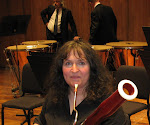
Carmina Burana is one of the best-loved symphonic works of all time.Many orchestras perform crowd pleasers such as this one regularly; the Columbus Symphony last performed Carmina Burana four years ago and I wrote a blog post about it.For this week's performance of Carmina, I made use of my last blog post. I reviewed it a few weeks ago and was amused by the reminder of my exhaustive search for the ultimate Cignus ustus cantatreed, which might be defined as a reed which plays easily in the extreme high range but is equally reliable in the extreme low range (if such a reed actually exists!). But my amusement soon morphed into the grim realization that I'd better get to work.
Although I thought I had saved my Carmina reed from the last performance, I couldn't find it. I found a box of reeds labeled "Carmina" but I was pretty certain that none of those reeds were the one. Then I noticed that I had posted a photo of the chosen reed on my blog. And after further searching, I actually found that reed.
My 2011 Carmina reed
Finally I'd be able to answer a question I'd been pondering for quite some time: is it really possible to save a reed over several years for a specific solo or work, and to actually be able to use that reed years later? Well, in this case at least, the answer is definitely no. My formerly stellar Carmina reed is now useless - not because it had turned moldy or anything obvious like that - it simply lost its special quality over the four years since its Carmina performances. Wood ages, after all, and the aging process inevitably affects playing quality.
However, it may be possible forreeds specializing in the low range, such as reeds which successfully execute the opening of Tchaikowsky Symphony No. 6, tobe saved for the future with good results. Low reeds are quite different from high reeds, and often older reeds are useful for low playing. High solos, though, seem to require much more reed-related fussing, in my experience. And high reeds have a much shorter shelf life.
So once again I had to go through a very large number of reeds to find the one which sounded best on Carmina. My plan was to have a selection of reeds to try in the Ohio Theatre, but the same thing happened as last time- I ended up with only one reed which sounded right, and no others came close.
I have a large stockpile of reeds which "specialize" in the high range. It takes a long time to go through all of the reeds. At the same time, I continue to make brand new reeds, in case one of them turns out to be a high reed (and I always prefer new reeds). The reason I go to such lengths to find the right reed is because I believe that in order for the solo to sound the way I want it to, the reed must cooperate at a very high level. No average reed can do that.
Is it like this for every orchestral solo? For me, yes. We're playing Tchaikowsky Symphony No. 4 next, and I have yet to find "the" reed for that. It's just as challenging to find a reed which has the right sound and control qualities as it is to find a good high reed.
When testing new reeds, I set aside any reed which demonstrates strength in either high or low playing. Some bassoonists claim to be able to manipulate any reed so that it willplay well in the extremities, but I have found such efforts to be nonproductive. It's impossible to control the innate characteristics of a piece of cane, so I prefer to allow each reed (each piece of cane) to letme know what it favors. Some reeds, unfortunately, let me know that they're not good for playing the bassoon, period! My reed making approach is to honor the tendency of each piece of cane, and that's how I end up with large stockpiles of both high reeds and low reeds (and, of course, piles of rejects!).
Another interesting experiment took place this week. One of the movements in Carmina requires the first bassoon to sustain low Gs, and the last G of the movement isheld for a long time. I noticed during the first performance this week that the reed I was using for this part (the non-solo part) of Carmina seemed to require more air than normal, making it very difficult for me to sustain the final G of the movement. Was it my imagination, or was this reed making my job unnecessarily difficult?
To attempt to answer that question, I brought out the metronome and a few reeds, including the one I'd been using. I held out the low G at a pianissimo dynamic while counting the beats for each reed. Sure enough, the reed I'd been using was requiring significantly more air than the others, and I couldn't sustain the note nearly as long with that reed. Once my suspicion was confirmed, I switched to a different reed and had a much easier time during the second performance. Had I not been so hyper-focused on the Cignus ustus cantat solo and its attendant reed, I surely would have figured this out sooner.
It has taken many years of bassoon playing for me to reach reed-related revelations such as this one.There are so many things about reeds that continue to surprise me, such as this newly discovered fact that each reed requires a specific amount of air in order to vibrate, and the required amount of air varies greatly from reed to reed. Also, some reeds are easier to tongue on than others. (I'll soon begin my search for a great double-tonguing reed for our upcoming performances of Beethoven Symphony No. 4.) Another fact which baffles me is that some reeds are actually easier to play fast on than others (while slurring)such as during the third movement bassoon lick of the Ravel Piano Concerto. (How on earth is a reed able to affect finger technique? I'd love to know.)
The bottom line is this: bassoon players need A LOT of reeds to choose from! Now, back to the reed desk........
"Unique" is not a strong enough adjective.....it's completely awesome. The Tafelmusik Baroque Orchestra offers an innovative concert experience called House of Dreams. Described as "a magical journey to the meeting places of baroque art and music", House of Dreams features five
European homes (located in London,
Venice, Delft, Paris and Leipzig) where, during the baroque era, concerts were performed in those very houses against a backdrop of paintings by Vermeer, Canaletto and
Watteau. In order to create this imaginative atmosphere, the House of Dreams concerts include stage direction,
narration, and projected images.
In the words of creator Alison Mackay (who also happens to be Tafelmusik's double bassist):
“House of Dreams is an evocation of rich and intimate
experiences of the arts in the time of Purcell, Handel, Vivaldi and
Bach. It’s a virtual visit to London,
Venice, Delft, Paris and Leipzig, where great masterpieces by European
painters were displayed on the walls of five private homes. These houses
were also alive with music, often played by the leading performers and
composers of the day.”
Just about everyone who is involved in classical music realizes that now, in the age of the internet and endless options for entertainment and leisure, the old-fashioned classical music concert (a straightforward performance of a list of musical works, no frills, attended mostly by season subscribers) is nearly an anachronism. Today's audience demands to be enticed. And Toronto-based Tafelmusik has figured out a great way to do just that.
The performance below of bassoonist Dominic Teresi performing the third movement of the Vivaldi Bassoon Concerto in e minor is featured in House of Dreams. As in all performances by Tafelmusik, each musician, including the soloist, is performing on a period instrument. (How is it possible to sound so good on a baroque bassoon?! In the capable hands of Dominic Teresi it sounds very much like a French basson.)
,
The quality of playing is amazing. (And I think the large lute - or is it a theorbo? - is the icing on the cake.) Even more unbelievably....and this is huge.... did you notice that each musician is playing from memory? Have you ever attended or participated in an orchestral concert which was played from memory - in which not just the soloist, but the whole darned orchestra played from memory? I haven't. What a fascinating concept; I wonder if the absolutely perfect ensemble displayed in this recording is partly enabled by memorization. All of the energy and focus which would have been devoted to reading the music and its many intricate details is now free to be applied to acute listening and world class teamwork.
If you are fortunate enough to live in a city which is included on Tafelmusik's current touring schedule, audience approval of House of Dreams has been off the charts. Check it out if you can!
Well, it hasn't been easy, but I've somehow managed to stick with my New Years's resolution to make a reed a day. Today, August 15th, the 227th day of the year, I made blank #227. Yay!
Blank #227 made on 8/15/15 (the 227th day of the year)
This fact would be unimpressive to a bassoonist who makes reeds to sell. But to me, this is high output.
One reason I like the concept of making a reed a day is because....please accept my apologies for stating the obvious.....I know exactly how many reeds I'm making per year (and per day and per week, etc.). I number each blank and keep a record of any changes, such as sharpening of the profiler blade. It's fascinating to see how such changes affect the reeds.
It's easy to experiment with cane using the reed-a-day method. In the past when I've made reeds during marathon sessions, it was impossible to try different types of cane and then make more reeds with the cane that worked. Processing reeds each day allows for effective experimentation, and by that I mean experimentation which is followed by immediate implementation of the conclusion. Normally, the phases of making a reed are spread out over a period of several weeks or even months, but when experimenting, I have found that it's OK to make a reed quickly, by wrapping a newly formed blank the next day and testing it immediately. (This has caused me to question my longstanding belief that the best reeds are made slowly, with new blanks remaining untouched for at least two weeks before further processing. Seriously, some of my best reeds have been made from blanks one day old.)
There's one drawback to making a lot of reeds, as I explained in a recent post. Much to my dismay, the profiler blade must be sharpened regularly (every 50 pieces of cane) in order to achieve the best possible results. So the more reeds I make, the more frequently I sharpen the blade....in order to make 365 reeds a year, I must sharpen my profiler blade a colossal 7 times per year! What punishment! On the other hand, I'll eventually become de-sensitized to profiler blade sharpening, and before long, I'll think nothing of it. Right?
How many reeds does a bassoonist need for a year? I suppose it varies a
lot depending upon the amount of playing per year and individual preference. I know some bassoonists who play on the same reed for months, amazingly. For me, a reed is worn out after a
week of playing on it, so obviously I much prefer to play on brand new reeds.
And, like all bassoonists, I like to have lots of reeds to choose from!
I try to always make enough reeds so that I'm maintaining a decent-sized stockpile, which was a strong recommendation of my teacher K. David Van Hoesen. Mr. Van Hoesen himself maintains a massive stockpile of recently-processed reeds to this very day, even though he doesn't play all that often.
GIF animation of K. David Van Hoesen in his living room
Mr. Van Hoesen is an eternal source of inspiration, with his students performing in many orchestras, including the top ten, throughout the U.S. His infinite wisdom and inimitable bassoon playing echo in the playing and the teaching of those who were fortunate enough to have been influenced by him. Even though he's retired, his basement continues to fill with newly-made bassoon reed blanks. Maybe someday he might be convinced to sell some of them!
Yep, it's that time....it's time to sharpen the profiler blade. In fact, it's been time to sharpen that profiler blade for a long time. The great bassoon pedagogue Norman Herzberg, who designed and created the profiler I use, issued very clear instructions to me as I stood before him in his Encino, California garage/reedmaking studio: "This blade is to be sharpened after profiling 50 pieces of cane. Got that? Every 50 pieces. That's non-negotiable." And then he proceeded to show me exactly how it's done.
He painstakingly demonstrated the technique of rubbing the blade the length of the sharpening stone with the forefinger on top of the blade, with the thumb pushing the blade along the stone. This was a new blade, so it didn't take long for a burr to develop on the tip of the blade, signalling that the blade was properly sharpened. At that point the blade was to be flipped over and given a couple of light strokes on the stone to get rid of the burr.
Solemnly I promised that I would sharpen that blade without fail each time I reached my 50th piece of cane since the last sharpening, and that truly was my intention. At that time I had no inkling of the sense of dread which would befall me each time I inched closer to number 50. In fact, I found myself using my very finest denial techniques to avoid sharpening the blade. For example, there was always the strong chance that somehow I'd botch the job, thereby ruining not only my profiler but also my entire (now reed-less) career.
I managed to convince myself that I was actually preserving the profiler blade by refusing to sharpen it. After all, each swipe across that diamond sharpening stone removed microscopic material from said blade, right? Sharpen it too many times, and it's gone. That's pure logic.
Oftentimes, it's difficult to find the correct position for the newly reinstalled blade. I rationalized that I wasted too many pieces of cane each time I sharpened the blade, since the only real way to know if the blade is in the right position is to actually use the profiler to profile a stick of cane. If the profile turns out too thick or too thin, the blade height is adjusted accordingly and then another stick of cane is tested on the profiler. And it's really difficult to get it right! Many pieces of cane are sacrificed during the act. Think of all the arundo donax being forced to make the ultimate sacrifice just so that I can sharpen my blade....
Finally I couldn't take it any longer. I knew the blade was barely functional - its cutting power by this point barely rivaled that of a chunk of cardboard. Worse yet, I was sure that Mr. Herzberg was rolling over in his grave due to the number of sticks of cane I had profiled since my last blade sharpening. It was mainly my debt of gratitude to Mr. Herzberg that lifted me out of my state of inertia. After all the years of research, experimentation and struggle he spent creating his state-of-the-art profiler, the least I could do would be to honor him by performing routine maintenance on the treasure he had bestowed upon me.
Thus the dreaded deed was undertaken. Having convinced myself that the task at hand was stupefyingly difficult, I didn't dare approach it without my original notes which I had hastily jotted down in Mr. Herzberg's southern California garage.
I re-read the notes, then got out the hex wrenches and diamond sharpening stone which he had given me, and then took photos of the profiler with both my camera AND my phone, in case the unthinkable occurred and I somehow botched the job. I wanted to be able to see a picture of the profiler before I wrecked it., so that I'd stand a chance of putting it back together the way it was. (I do this each time I sharpen the blade, as if I've never done it before. Maybe it's good to always approach a task as though for the first time......I'm not sure.)
one of the photos I took of the blade assembly in case I bollix the reassembly
another photo of the blade assembly
In yet another act of compulsive overkill, next I drew a diagram of the cutting head assembly, even though I already had several diagrams of that same cutting head in the notes I had just re-read.
Then I unscrewed and removed the cutting head shaft handle, thereby clearing the way for the grand disassembly......
Finally I took the plunge, inserting the hex wrench into the set screw while turning the nearby knob for the notch. Before I knew it, the hitherto-eschewed blade was in my hands, slippery like a fish out of water. I saw that the edge was kind of shabby looking, slightly jagged.
profiler blade before sharpening, looking kind of rough
Earlier that day I had received a pep talk from a bassoonist friend who understood my trepidation. I had admitted to him that I had little confidence in my profiler blade sharpening skills. I had elaborated on that theme, explaining that I had never really understood the "burr". What the heck was a burr? How did one know if the burr was there or not? I myself had never experienced a burr, as far as I knew, and I had always given up on the elusive burr, flipping the blade over and giving it a couple of light strokes on the other side anyway, as if I had found a burr.
During this heart-to-heart with my commiserator, I came to realize that it was my sense of guilt over my failure to produce the elusive burr that was blocking my profiler maintenance duties. My friend assured me that it takes a long time to reach the burr phase, longer than expected. It's not like sharpening a knife, I silently acknowledged. It takes a long time to produce a burr on a hardened steel profiler blade. Ah-ha. I didn't know that.
So I stroked. And stroked. And stroked some more. No burr. I was afraid I would damage my forefinger atop the blade during all of these strokes, as though my finger was being sharpened along with the blade. I kept pushing that blade with my thumb, wondering how all of this friction could seemingly have no effect on the stubborn blade. I rested. Then stroked, stroked, stroked some more. And tested the blade for the burr. And stroked more. And tested.
This went on for a long time, which was what my friend said was necessary. I knew the blade was sharp, having accidentally cut myself on it, but still no burr. And I kept stroking and stroking.
the blade resting on the diamond sharpening stone
Finally, after what seemed like an hour or two, I sensed something different on the tip of the blade. Could it be??? Was this a BURR??? I wasn't sure, but it was different, so I kept stroking with renewed enthusiasm and tested the tip again. Yes, if it wasn't a burr, then it was some sort of alteration of the tip of the blade which was discernible to the touch. And when I flipped it over and gave it a couple of light swipes as Mr. Herzberg had instructed on that hot, dry California day so long ago, the burr disappeared as though it had been but an apparition.
profiler blade after sharpening, looking mighty impressive if I do say so myself
Could it be that this was the first time in my life I had experienced a burr on the blade? I daresay it was. When I reassembled the profiler and made the first reed with the sharpened blade, it was as though the machine was brand new again. It worked like a dream, cutting that cane as though there was nothing to it. Reedmaking could actually be a much more enjoyable activity, I thought, with such a well-functioning, well-honed machine cutting the reeds for me.....how much more satisfying could reedmaking possibly be?
In the interest of honesty, I must admit that I think the blade is a hair too low, meaning it's cutting a little too much cane off the reed. But this profiler is like a racehorse given full reign to unleash its extreme strength, speed and competence. If the reeds prove to be too thin, I'll move the blade up a bit tomorrow. But for now, I bet Mr. Herzberg is smiling ear to ear.
When I first set out to post my favorite YouTube recordings of bassoonists, I ended up with way too many recordings, but ultimately I decided to narrow it down to three. Without a doubt, German bassoonist Klaus Thunemann is the player whose recordings I have listened to the most over the years. I especially like his Baroque recordings, such as the Vivaldi bassoon concertos below. He provides great examples of Baroque ornamentation (embellishing the music beyond the printed part).
I had the great pleasure of meeting Arthur Weisberg seven years ago. I was glad to have the opportunity to tell him how he had influenced my career. When I was in high school I heard him perform with the New York Woodwind Quintet, and I'll never forget the way he made the bassoon sound easy to play. Later, I learned how to double tongue from his phenomenal book The Art of Wind Playing.
Nadina Mackie Jackson has created an amazing career as a bassoon soloist. In the video below she briefly talks about finding the voice of the reed, and then demonstrates.
These three bassoonists are virtuosos whose command of the instrument lies well beyond the norm. Their demonstrations of what's possible on the bassoon provide inspiration for other players, and hopefully for composers who will be drawn to our instrument!
Pyotr Ilyich Tchaikowsky was one of those rare composers who had no fear of featuring the bassoon in major orchestral solos. What caused his lack of trepidation? I've spent some time researching his life, and found no obvious clues. (Was he in love with the sound of the bassoon? Had his favorite cousin played it? Did he feel sorry for the underdog of the orchestra? Had he played it in 7th grade?) There's no question that the man chose a rather colorful, perhaps even risqué lifestyle. Maybe that's it.......his generous use of the bassoon reflected his proclivity for color and risk-taking, perhaps?
Recently the Columbus Symphony performed Tchaikowsky Symphony No. 5 on a program which opened with the Brahms Piano Concerto No. 1. The Brahms second movement Adagio (widely recognized by bassoonists as a serious chop-buster) features extensive exposed passages which are mostly in the tenor range of the bassoon:
In an orchestra with an assistant principal bassoon, this type of program is no problem. The assistant plays the Brahms and the principal plays the Tchaikowsky. But in many orchestras (mine, for example) the principal plays everything and must figure out how to make it work.
The solution lies in the reed, as so often is the case. As bassoonists know, reeds vary regarding embouchure strain. For the Brahms I used a reed which was rather easy on the embouchure - it required minimal embouchure adjustment from note to note, especially in the tenor range. Thanks to that reed, my embouchure remained intact for the Tchaikowsky. Reeds which wear out the embouchure are very easy to identify - the embouchure feels noticeably tired while using the reed. The opposite type of reed is not as obvious; in order to find a stable reed I tested a number of reeds, searching for any reeds which "automatically" played in tune on certain tenor range notes such as Bb3 (the 3rd Bb on the bassoon starting from low Bb), D3, and Eb3. Each bassoon is different, but on mine, those particular notes tend to vary in stability and pitch tendency from reed to reed. The stability (and ease on the embouchure) of a reed may be determined by seeing how readily a reed plays those notes in tune with minimal embouchure adjustment.
The second movement of the Brahms, pictured below, offers the perfect test of a reed's stability. The tempo, Adagio, can be quite slow, depending upon the soloist and conductor.
The ending of the movement (above) is yet another test of the reed. If your chops are tired, the D2 may be sharp, and the last thing you'll want to do is ruin the movement (yes, it's exposed) with a sharp D at the end!
Of all of Tchaikowsky's compositions, his Fifth Symphony is perhaps the most bassoon-rich of them all. After the unison clarinets open the symphony, the first clarinet and first bassoon enter with the second theme in octaves:
bassoon part of soli in octaves with clarinet, Tchaikowsky Sym. No. 5, mvt. 1
In the Ohio Theatre where the Columbus Symphony performs, the acoustics and stage setup create a situation
whereby it's not a good idea to listen to the string accompaniment
leading to the above-pictured soli. That's because if the clarinet and bassoon play along with what we hear, we'll lag behind the strings due to the aural delay caused by our distance from the strings. It's necessary
to watch the conductor rather than to listen in this type of situation.
Of course, this goes against our training. Music students are constantly implored to listen. But the first thing I had to do upon arrival in Columbus was to learn that if I listen to the strings on the Ohio Theatre stage, I'll be late (in situations where the bassoon and strings are playing, with the rest of the orchestra silent). If I anticipate, playing slightly ahead of what I'm hearing, or simply watch the conductor's baton, then I'll stand a chance of accurate ensemble with the strings. Of course, each concert hall is different, and the setup of the orchestra can largely eliminate the problem. If the strings are seated back near the woodwinds or if the woodwinds are situated fairly close to the front of the stage, the problem is remedied. In Columbus, the woodwinds are situated towards the back of the stage. The strings are fairly distant from the bassoons, causing the sound delay. Again, I want to be clear that this phenomenon I'm describing applies when the bassoon (also with clarinet in this case) is playing with the strings. If the accompanying musicians are winds, brass or percussion, there is no sound delay, because those instruments are situated near or behind the bassoons, and listening IS reliable. And if all or most of the orchestra is playing at once, there's no problem. The issue I'm describing only arises during sparse instrumentation when the bassoon is playing with strings.
Later in the movement the bassoon alone plays the same theme, with slight changes. In my part, this solo is located down at the bottom of the page. Looking way down at the bottom of the page makes it difficult to see the conductor. (Even though I could play it from memory, that's not what orchestral players are used to. We're quite visually oriented, and in this particular solo, I want to see the slight differences which distinguish it from the earlier soli with clarinet. Even though I rarely need to see the music, especially for a solo, there is the possibility of becoming disoriented if anything interferes with the visual, such as glancing up at the conductor and then not being able to find my place in the music after diverting my eyes. So I wrote out the solo and taped it across the top of the pages, like so:
This may seem like overkill, but to me it makes a big difference. Even though it's a solo passage, it's still necessary to remain in touch with the boss (the conductor).
At the end of the first movement is an exposed passage which is written for two bassoons in unison beginning in measure 527. (See below, but don't pay attention to the old markings in the part pictured below.
They were too hard to erase, which is why they're still there.) It's advisable for the principal to play alone from measure 531 to the end in order to avoid any possible intonation clashes between the two bassoons. (This especially makes sense due to the dynamic range: pp to ppp!) Also, if only one bassoon is playing, the conductor is less likely to wince at snarling low Bs at the end. I've noticed that many conductors really seem to keep things moving along at the end of this movement, mercifully. (There's no use in prolonging the question of whether or not the bassoon's low Bs will mesh well with the timpani, cellos and basses.....)
The second movement opens with the famous and beloved French horn solo. Soon afterwards, the bassoon follows the clarinet in the following five-note solo:
Although the brief solo looks simple and easy, these are not necessarily the easiest notes to play in tune and with a well-matched sound from note to note. I use the alternate F# fingering for the first note, but not just for technical reasons. The alternate F# also produces a more mellow sound and slightly lower pitch than the standard fingering. For the A# I find it necessary to drop my jaw as an embouchure adjustment to ensure that the interval is in tune, since the A# is one of those notes which, left to its own devices, might be sharp, especially when approached from a higher note. (On the bassoon, some notes vary in pitch depending upon whether the preceding note is higher or lower pitched than the note in question.) The phrase leads to the D, and ends with a taper on the D and C#. It's advisable to listen closely to the clarinet playing this solo, and to imitate the pitch, the phrasing and the timing of the clarinet solo. That means minimal vibrato, if any. Also, there's a good chance that the clarinetist won't make a big deal out of this passage - he'll keep it moving along. If so, the bassoonist should do the same. Whoever plays first sets the rules. Of course, if the conductor relaxes the tempo for the ending of this bassoon solo, so be it.
The next bassoon solo is one of my favorites despite its challenges. Once again, the bassoon solo follows the nearly identical clarinet solo an octave higher. The clarinet has no trouble soaring above the orchestra on this passage. It's a good idea to strive to match that, and to do so without pushing up the pitch of the high B. High B is one of those notes that tends to go sharp at higher dynamic levels, so be sure to loosen the embouchure and keep the pitch down. Rubato is appropriate here; a slight tenuto on the high B can sound good as long as it's not so long as to sound affected, and the G# (the second to last note) can be stretched. Romantic era works easily lend themselves to such icing on the cake.
Then at letter E (see above) the bassoon must somehow project over the thick orchestration. Whenever I play this passage in rehearsals or concerts, the orchestra sounds really loud and I feel as
though I must blow my brains out to be heard Our guest conductor Thomas Wilkins
never complained about the bassoon not projecting there, so it must have
been better balanced than I thought. I'm pretty sure that my face turned red
from exertion, but that's OK. Here's what my teacher K. David Van Hoesen used to say about passages like this:
"If you're not turning red
in the face there, then you're doing something wrong!"
And of course the bassoon is rather prevalent in the Valse movement. The first solo passage beginning with the pickups to measure 19 is in octaves with the solo oboe. This soli is well-served by exaggerated yet smooth crescendos and decrescendos, punctuated by light staccatos at the ends of measures 25, 26 and 27. The prevalent feature, though, should be elegance, I think.
At letter B (see above) the bassoon joins the clarinets in unison. The goal is just to discreetly fit in with what the clarinets have already been doing. I think it's ideal for the bassoon's entrance to be noticeable only due to the pleasant yet subtle change of color. The bassoon should not use vibrato, since the clarinets most likely won't be using it. One of the bassoon's outstanding characteristics is its ability to blend with other instruments, and the blending process requires matching the vibrato or lack of vibrato of the other instrument(s).
The big solo begins with the three eighth notes at the end of measure 56 (above), and traditionally, those eighths are often played at a suddenly slower tempo. Some conductors, such as Maestro Wilkins, allow the bassoon soloist to take charge here. I played the first four notes a bit slower and at a louder dynamic, with the next four-note phrase in tempo and as a pianissimo echo to the opening four notes. Then the rest of the solo gradually increased in volume until the f of the syncopated section. It's good to keep an eye on the conductor to be sure the timing is right, especially after the syncopation begins. Lots of preparation with the metronome helps the bassoonist feel more secure in this unusual and somewhat awkward passage.
Awkward though the slurs may be in the syncopated section, it's necessary to see to it that each note speaks on time, come hell or high water. Sometimes for the downward slurs, the lower note benefits from a dramatic dropping of the jaw. Also, some reeds are more reliable than others for such wide interval slurring. (Yes, it seems that the number of factors affected by the reed is infinite!)
I prefer to be able to really see the conductor during the solo, so once again I wrote out the solo on staff paper and taped it to the top of the page (see below). The orange sticker near the bottom of the second page shows my eyes where to go after the solo (once the other woodwinds join in).
The experience of performing any orchestral work varies greatly depending upon the conductor. I think that my colleagues and I enjoyed Maestro Wilkins' approach which allowed us a great deal of freedom during solo passages.
Mozart's Le nozze di Figaro Overture 1st bassoon part
The Overture to Mozart's Le nozze di Figaro (The Marriage of Figaro) is one of the top five bassoon orchestral audition excerpts. In fact, this overture is probably one of the top 20 pieces performed most frequently by symphony orchestras. It's short, showy, charming, and, well......it's Mozart!
We bassoonists spend many an hour perfecting our parts to this overture. From our work on this bassoon part we develop a smooth, discreet, agile style of playing which blends admirably with strings (hopefully). This delightful overture has raised the standard of playing for more bassoonists more than any etude ever has, I'm quite certain.
OK, so bassoonists are well aware of the overture to The Marriage of Figaro. We can pretty much play it in our sleep. But what about the rest of the opera?
Many consider Mozart operas to contain some of the most glorious music ever written, andthe comic opera Le nozze di Figaro is a gem of the operatic literature. This is what Johannes Brahms had to say about it:
"In my opinion, each number in Figaro
is a miracle; it is totally beyond me how anyone could create anything
so perfect; nothing like it was ever done again, not even by Beethoven."
The plot a complex, far-fetched soap opera taking place on the wedding day of Figaro and Susanna, who are servants of Count Almaviva. Figaro is dismayed to learn that the Count has his eye on Susanna, so he devises a plan to send the teenage boy Cherubino disguised as Susanna to meet with the Count. Unfortunately, the Count arrives unexpectedly before they manage to pull off the scheme. Then it turns out that Figaro owes money to a certain Marcellina. Sadly, he had promised the older woman that he'd marry her if he couldn't cough up the money. Marcellina shows up with her lawyer Bartolo to collect either the money or the marriage when suddenly it is discovered that Marcellina and Bartolo happen to be the bioparents of the adopted Figaro. They decide to hold a double wedding with Marcellina marrying Bartolo and Figaro, of course, marrying Susanna. Meanwhile, the Countess has devised a scheme of her own to win back the attention of her husband. She dresses as Susanna and meets with the Count. Her trick pays off and her husband is besmitten anew.
Here is one of the many unforgettable arias from the opera, this one delivered by the adolescent boy Cherubino (nearly always performed by a seasoned mezzo-soprano, in this case Rinat Shaham):
Bassoonists, see if the following aria, Pargi, Amor, sung by the Countess (Jessye Norman in this case) at the beginning of the second act rings a bell:
Yes, indeed. For this aria Mozart used the motif from the second movement of his own bassoon concerto! If we ever need inspiration for preparing that movement, now we know where to turn.
If you're a bassoonist, there's a chance that someday you'll perform one of the bassoon parts for this opera, if you're lucky, as I am this week with the Columbus Symphony and Opera Columbus.
Mozart's The Marriage of Figaro
Friday, March 6, 8 pm Sunday, March 8, 2 pm
Southern Theatre
Opera
Columbus presents one of the greatest operas ever written, Mozart's The
Marriage of Figaro, performed in English with the Columbus Symphony!
But I must warn you that there are a couple of fast tonguing passages in this opera which rank among the fastest passages I've ever been asked to play. Ever.
The first such passage shows up at the end of Act II:
At first glance, it doesn't look like much. But I assure you that the Prestissimo is fast, and I mean FAST. It's in one - a fast one. I swear, I'm double-tonguing as fast as I can to get through this. It almost sounds comical (it is a comic opera after all).
The next example is even more formidable, although, as in the first example, it looks harmless enough until you actually realize how fast it is:
In measure 487 above, notice the words "Piu mosso" penciled in. Yes, it's faster. The whole page is in one, but at 487 the tempo is fast as can be, and as you can see, there's a lot of tonguing to be dealt with. My advice is to practice the passages all slurred to be sure that your finger technique is flawless. That's at least half the battle. Then practice your tonguing on a single note up to tempo to assure yourself that you really can tongue that fast. Of course, the assumption is that you are able to double tongue really well. This passage and the one above it are really too fast for even the fastest single tongue. Both of the above excerpts appear in the 1st and 2nd bassoon parts.
Once you've practiced the notes with slurs and then the double tonguing on a single note up to tempo, then all you have to do is put the two together. While playing it in the orchestra, try to remain calm and be aware of the tempo being played by the rest of the orchestra. It really is playable, although the first time we read through it I didn't think so!
All that tonguing is a small price to pay for the privilege of performing this miraculous Mozart masterpiece, as I'm sure you'll agree. If you live in the Columbus area, please consider attending one of our performances this weekend. As an added enticement, central Ohio native Adam Cioffari (whose mother is bassoonist Cynthia Cioffari) will be appearing as Figaro!
Favorite blog posts, August 2026
-
Hand-picked high-quality woodwind-related blog posts from around the web,
August 2026 edition.
------------------------------
If you enjoyed this blog po...
Some Wonderful Music For You
-
VOCES8 is singing, so it’s pretty amazing. Stephen Paulus: Pilgrims’ Hymn
TEXT by Michael Dennis Browne Even before we call on Your name To ask You,
O God,...
MRI of an opera singer
-
This has been sitting in my drafts for nine years. Absolutely amazing, to
see how they dynamically reshape their anatomy to make the sound. And
apparentl...
13-yr old Phenom!
-
Like this video of a performance of the Weber Concerto 1st movement by
13-year old Kevin
Zephyrin.
He is competing in a competition and can win if enough ...
Garfield Plays Hindemith
-
German composer Paul Hindemith wrote more than forty sonatas. In addition
to at least one sonata for each standard orchestral woodwind, brass, and
string i...
Cello Perspectives With WFMT
-
I had the pleasure of participating in WFMT’s cello month, which is
planning to broadcast Songs My Father Taught Me on January 31st at 10:00 PM
Central Tim...