Friday, April 8, 2022

Playing the bassoon in an orchestra


If you are a student or amateur musician who is playing in an orchestra and no one has advised you on the unofficial "rules" of orchestral playing, then this post is for you.  I had the opportunity to hear an amateur orchestra rehearse recently and it struck me that the bassoonists and other woodwind players could have used a few pointers to enhance their orchestral playing experience.

During the rehearsal I heard the conductor (who was apparently inexperienced) instruct the wind players to go with what they heard from the piano soloist instead of watching his baton.  That piece of advice contradicts my experience in the halls I've played in.  In fact, if the winds go with what they hear from a soloist in front of the orchestra, those wind players will end up lagging behind due to the distance between the soloist in the front of the stage and the position of the wind section.  Light travels faster than sound, so the visual guides (such as watching the conductor's baton or the movement of the string bows) are actually FAR more reliable than the aural guides, in situations where the winds or bassoons are on their own, trying to play with a soloist.  However, when the entire orchestra is playing OR if players beside or in back of the musician are playing---then the sound IS reliable.  For example, a bassoonist can listen reliably to brass or percussion player situated behind the bassoons or clarinet players beside the bassoons.  But it is not helpful to use the sound of a musician (or a section, like the first violins) located in front of you at a great distance, because your ears are hearing a delayed sound.  You'll be lagging behind!

This was probably the most difficult orchestral lesson I had to learn when I began playing principal bassoon in the Columbus Symphony.  While I was a student at Eastman I was fortunate to have the experience of playing second bassoon in the Rochester Philharmonic.  That was much easier because I was following the principal bassoonist, and the delay described above was his problem, not mine.  I wasn't even aware of the issue!  But once I began playing principal in Columbus I was constantly being told that I was behind until one day I asked for advice from a percussionist.  He told me to go with the conductor's baton.  Since then, I've been fairly conscientious about playing right on top of the conductor's beat, and the problem has been greatly alleviated.

If you want your ensemble playing to be as precise as possible, then have your eye on the baton either directly or peripherally whenever you are playing an exposed passage.  Again, if the entire orchestra is blasting away, that's when you can just relax and trust your ears.  The rest of the time, keep your eye on the baton either directly or peripherally.

Pay attention to your rhythmic accuracy.  Subdivide.  Watch out for coming off of ties (many musicians hold the tie too long due to failure to subdivide).  Don't play dotted eighth and sixteenth figures like triplets (again, subdivide).  Be aware of the very human tendency to rush.  (Practicing with a metronome really does help with that!)

Listen closely at all times to the other players so that you're able to match the style, volume, note lengths and articulations.  Good orchestral players are good listeners, as though they're playing chamber music.

Whenever you have a passage which has already been played by another musician before you, it's your job to match whatever that other musician did (even if it was distasteful).  I learned that from conductor David Effron at Eastman and that concept has been confirmed by many conductors since then.

These days many musicians practice with tuners.  Your orchestral playing will be enhanced by this, especially if you practice with a sound drone instead of a meter to develop a solid habit of listening for intonation.  For bassoonists especially, it's wise to check in occasionally with the visual tuner (instead of the tuning drone) just to be sure.

When playing a chord in a wind section, do not use vibrato. (Tuning is challenging enough without introducing vibrato into the mix!)  Chords in a wind section are best  tuned from the bottom up, which usually means that the wind section uses the second bassoon pitch as its reference . When playing passages with oboes or flutes (especially flutes), use vibrato as they do.  No vibrato is used when clarinets and bassoons are playing exposed passages together, since clarinets do not use vibrato.  The same is true for playing with horns.  Generally, vibrato enhances projection and is often used liberally for bassoon solos.  But in any passage where your goal is to be discreet or innocuous, it's probably best to leave out the vibrato.

The bassoon is the chameleon of the orchestra, having the ability to blend with any other instrument quite well, using our various tools of vibrato or lack thereof, dynamics and articulation.  It is also the quietest instrument.  When a bassoonist has a unison solo with another instrument (such as the horn), I have found that it's best to defer to the other instrument rather than attempt to assert my own sound.  That results in a better blend.  That also helps with matching the intonation, because if you're playing too loudly, it becomes much more difficult to hear the pitch of the other player(s).

Learn the music before the first rehearsal so that you know where your entrances are and where you'll be exposed.  That includes listening to recordings and studying scores so that you'll know how your part fits into the orchestral texture.  Don't be afraid to mark you parts with helpful information.  The first time you make a mistake, such as playing a wrong accidental, should be the last.  Mark it with a pencil to ensure that it won't happen again.  Learn to anticipate where you might be likely to play a wrong note, and mark it in advance.

Finally, there are a couple of etiquette rules.  Be very, very careful when walking near instruments on stage.  I usually go out of my way to avoid walking anywhere near an unattended instrument (whether it's in an instrument stand or laying on a chair).  Also, try to resist the urge to turn to look at other players while they're playing (or after they finish).  When considering approaching other wind players about ensemble or intonation issues, be aware of the benefit of choosing one's words very carefully!  Whenever a musician seated near you (especially beside you) is playing a solo or exposed passage which does not include you, it’s your job to FREEZE!  The last thing you want to do is distract another musician when they’re in the hot seat.  (With any luck, your woodwind neighbors in the orchestra will return the favor when it’s your turn to solo.) 

Once you've prepared as thoroughly as you possibly can, you've earned the right to just show up and enjoy the experience!   Listen to the music as it unfolds and play your part with total commitment.


Thursday, December 2, 2021

tools needed for bassoon reedmaking (using GSP cane)

These days many bassoonists forgo the burden of purchasing and maintaining a gouger, a profiler and a shaper, especially since there are several reliable sources of processed cane.  Although I profile and shape my own cane, I prefer to teach students to make reeds using cane which is already gouged, shaped and profiled (also known as GSP cane).  To make reeds using GSP cane, the following tools and supplies are required (according to my specific method of forming and finishing blanks):


GSP cane (Barton Cane is a popular source)
forming mandrel (the mandrel used for forming the tube)
holding mandrel (the mandrel used for holding the reed for wrapping or finishing)
double hollow ground knife
flat file 
rat tale file
reamer
plaque
#22 brass wire
#3 cotton crochet thread
Duco cement (or beeswax if you prefer a nontoxic alternative)
ruler
scoring tool or hacksaw blade
cutting block
broom handle
sanding block (can be made by gluing sandpaper onto a wooden block)
parallel pliers
pruners (the cheap kind, such as from the dollar section at Target)
pliers
tip cutter (the tip may be cut using a cutting block and a knife, but the results are often disappointing)
long brass forming mandrel tips from Christlieb Products.


Sunday, May 31, 2020

Rhythmic fingering on bassoon--a K. David Van Hoesen concept

Rhythmic (or rhythmical) fingering is a concept I rarely hear about these days, yet during my student years at the Eastman School of Music I heard about it plenty from my teacher, K. David Van Hoesen.  He believed that rhythmic fingering was an important (yet often ignored) aspect of bassoon playing.  When he first brought it up in one of my lessons, he admitted that it could be very difficult to teach.  Then he mentioned that one of his students who was particularly sharp (not in pitch, but in brainpower!) had picked up on it instantly.  I wanted to be like that student, so I've been applying the rhythmic fingering concept since that very day.

Imagine playing a series of notes all slurred.  Your fingers move from the note you're on to the next note at the precise moment of changing notes.  Next, remove the slur and play each note staccato.  Unless you've been trained to use rhythmic fingering, you will likely notice that your fingers move early, in anticipation of the next note rather then waiting until the precise moment of changing notes.  Of course if you use rhythmic fingering, then your fingers will move exactly the same way they moved when you were slurring.

Why does this matter?

As K.David Van Hoesen used to say, many difficult passages can be smoothed out with a rhythmic approach to fingering.  It certainly reinforces rhythm when tongue and fingers are synchronized.  Besides, it's awfully hard to imagine a valid argument in favor of haphazard movement of the fingers.  How can that possibly lead to clarity and rhythmic accuracy?
 "Obviously in slurred passages the tongue and fingers must be coordinated, but in separated note passages (tongued passages) the same coordination between tongue and fingers should be present, but often isn't."  - K. David Van Hoesen
Finger/tongue coordination is a consciously developed habit. When fingerings and tonguing are both rhythmically conceived, they will always coincide.  If my students have trouble with tongue/finger coordination in a tongued passage, I instruct them to play the passage all slurred, thereby establishing rhythmic fingering.  Once the passage is rock solid all slurred, then the articulation is added.  This method works amazingly well.
.


.


Share

Tuesday, May 26, 2020

Beeswax for Bassoon Reeds

Shortly after starting my job with the Columbus Symphony, someone contacted me to ask if I taught bassoon lessons.  I wasn't sure how to respond, since I was busy trying to figure out how to play principal bassoon in an orchestra and felt that I had my hands full with that.  Teaching was not really on my radar.  So I called my teacher, K. David Van Hoesen to ask him if I should teach.  He said yes, I had to teach....I'd learn from my students.....teaching would force me to analyze what I'm doing.....it would help me figure out what works and what doesn't......etc., etc. He convinced me that teaching protects against complacency and stagnation.  So I taught.

And he was right, as usual.  A recent example of learning from my students has to do with sealing bassoon reeds.  Many bassoonists use glue to secure the binding on the reed and to prevent leakage and shifting of the blades.  I always used Duco Cement even though I have long been aware of its toxicity.  One of my students at the Capital University Conservatory of Music asked if I'd ever used beeswax to seal reeds.  No, I hadn't, and I was only vaguely aware that some reed makers do use it.  Further investigation ensued.

First I bought a brick of beeswax for $10.95 on Amazon.  Then I researched the matter online.  The one complaint I read about using beeswax was the problem of the binding becoming loose.  The way I make reeds, Duco cement is applied underneath the binding before wrapping the reed.  This prevents the binding from shifting later.  Once I began this practice, I have not had any issues whatsoever with loose binding.  So if Duco cement can be used underneath the wrapping, it stands to reason that beeswax can be used as an alternative underneath the wrapping.  The wax is fairly easy to place where it needs to be on the blank, and then a heat source such as a candle flame is used to melt it slightly, making it harden and adhere to the reed.

My students at Capital University were concerned about candles setting off the fire alarms.
(Note: This speaks volumes about their level of maturity......I recall my classmates at Eastman purposely setting off fire alarms for entertainment, especially at the dorms in the middle of the night!)  My Capital University students are not only mature-- they're also innovative.  One of them solved the fire problem by coming up with the excellent idea to use a soldering iron as the heat source.

Here is a Capital University bassoon major demonstrating the application of beeswax to seal the reed, both underneath and then on top of the wrapping.  He is using a battery-operated soldering iron (cost:$22.81):


The reed is immediately available as soon as the beeswax is applied....it hardens immediately.  You can soak the reed, cut the tip, play on it, and proceed with finishing right after applying the beeswax. The immediate availability of the reed after wrapping is a big plus, along with the non-toxicity.

CONCLUSION:

We had mixed conclusions, ranging from liking beeswax enough to use it exclusively to planning to never use it again.  My opinion is that I found the beeswax too messy to deal with efficiently and effectively, perhaps because the beeswax I ordered was the cheapest available (or because I'm a klutz when it comes to the manipulation of beeswax).  I shared one student's observation that the binding was not secure enough....I was afraid the beeswaxed reeds might fall apart at an inopportune moment!  Most importantly though, it took too much time.  I'm already a slow reed-maker, so adding a few more minutes onto my time required to make a reed is not an option.  I'm disappointed though, because I love the fact that beeswax is nontoxic (assuming the bees were not exposed to pesticides or herbicides).  I have not sworn off beeswax forever; I'll probably give it another try someday, maybe with a higher quality beeswax.

We "gave it the old college try" as my teacher K. David Van Hoesen used to say.  If worse comes to worst and you decide you prefer not to use beeswax after trying it, you can always make beeswax candles out of it!


Share

Thursday, January 23, 2020

The devil's in the details (Columbus Symphony Russian Winter Festival II)

This week the Columbus Symphony is performing a program of exotic masterpieces as part of its Russian Winter Festival.


This is the program:
Prokofiev - Lieutenant Kije
Borodin - Polovetsian Dances
Rimski-Korsakov - Suite from The Golden Cockerel (Le Coq d'Or)
Tchaikovsky - 1812 Overture
(And there's also an encore which shall remain a secret.)

The bassoon is not featured heavily in this program as a solo instrument but there is always plenty to keep us occupied.  The details can be daunting.....I noticed that there were 3 intervals which captured much of my attention this week.  An interval, in case any non-musicians are reading this, may be defined as the distance between two notes.  And one of the main intervals vying for my attention this week is the one which opens the first movement Lt. Kije bassoon solo (played here with a metronome on 80 and a drone on Bb):


Often there is a noise between the high Bb and the F below it, thereby ruining the interval.  Smooth playing is one of the great challenges of bassoon playing...left to its own devices, the bassoon sounds pretty rough and rocky.  But in the hands of an aware player, many of those rough edges are smoothed out.  It takes some work though.  To master the interval from high Bb to F, the air and embouchure must be subtly manipulated AND the finger movement from the Bb fingering to the F must be absolutely perfect.  We must will the bassoon to cooperate, as thortugh we're reining in a defiant toddler.

In that same solo, sometimes the Bb to the E natural is also a troublesome interval, benefiting from an embouchure shift on the E.  And finally, the low D to the low Bb might be awkward.  For me it requires a forceful movement of the left thumb.  By this point in the solo, the player has surely moved back on the reed, so the main problem here is the swift and strong motion of the left thumb.

I recommend practicing this solo with a metronome.  The reason is because this is one of the many solos in which the bassoonist tends to lag behind.  Practicing with a metronome prepares the player to keep the tempo moving throughout the solo. I looked at the score to see if there was a tempo marking, and sure enough there was: 80 beats per minute.  As always, though, I practiced with the metronome on faster and slower tempos so that I'm prepared for anything.

Many recordings of this piece feature faulty intonation in this bassoon solo.  Practicing the solo with a sound drone on Bb will greatly reduce the chances of playing out of tune on the solo in the orchestra. This level of preparation may seem like overkill but I think pays off.  It's better to be over-prepared than under-prepared.

There is a tricky technical passage in the second movement of Lt. Kije which presents a different type of interval challenge - one that is solved by the fingers exclusively - between low Eb and low Gb:


I use the alternate F# key (little finger right hand) but it can be difficult to slide the little finger from the low F key to the alternate F#.  Once again, extra force is needed.....that little finger has to work hard to move cleanly from F to F#.  I recorded myself (with my phone) playing the first 2 bars of the passage a couple of times, clearly establishing the difference between the quintuplet and the four 16ths.  With a precarious passage like this one, recording it accurately provides a degree of assurance for later playing it in the orchestra.

All four of the above mentioned intervals benefit from isolated practice (meaning practicing only the interval).  I recall many a lesson with K. David Van Hoesen when one interval would be played over and over, with discussion, until it really sounded ultra smooth and connected, with the first note clearly leading to the next.  He frequently began lessons by asking to hear a broken arpeggio all slurred, paying very close attention to each interval.

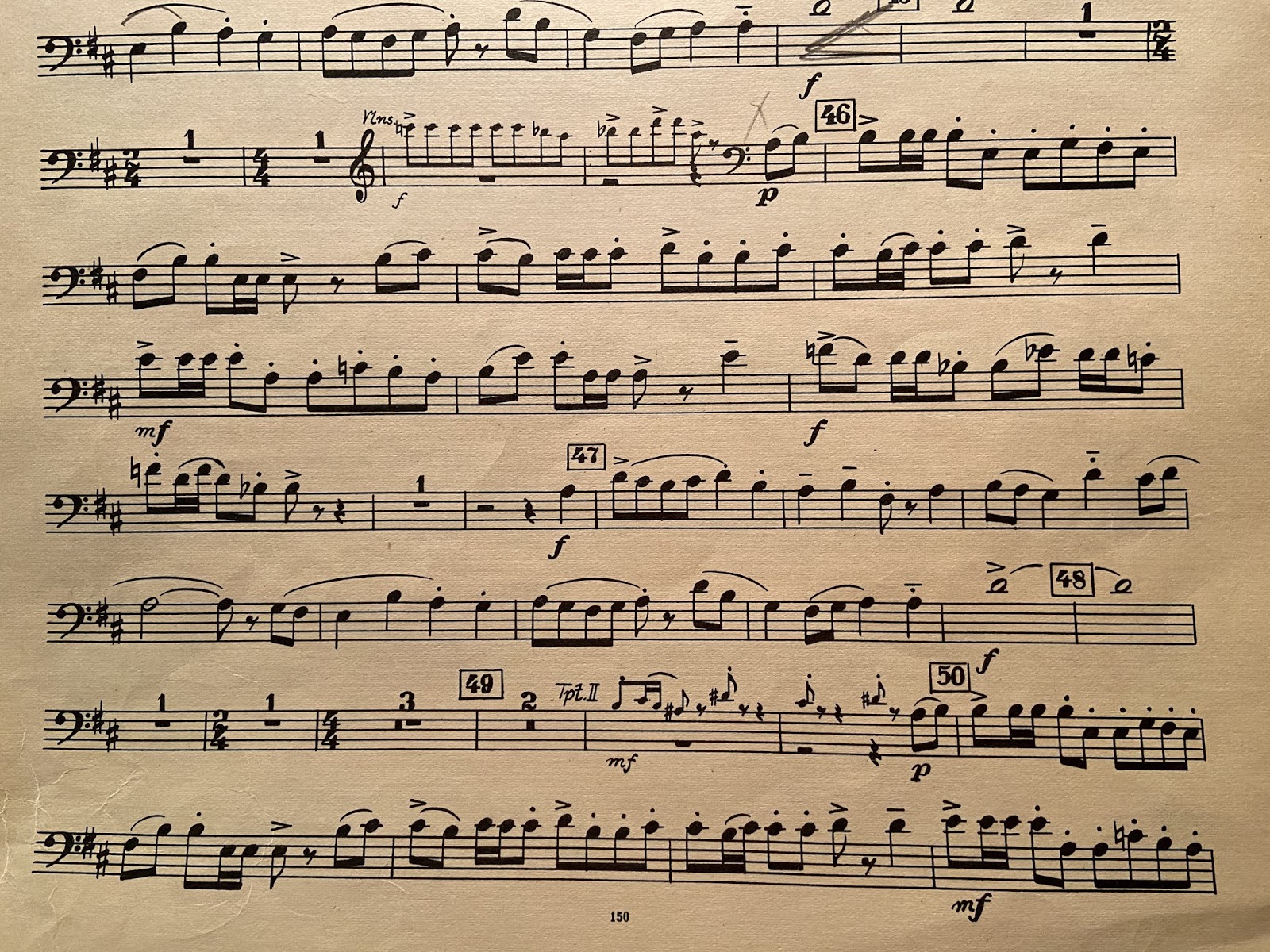
The 4th movement of Lt. Kije features two bassoons and a tenor saxophone in a unison soli beginning a beat before 46:


Good intonation and ensemble are of paramount importance here.  The staccatos are ideally crisp, with clear accents, including the accented eighth at the end of each phrase (which may be the opposite of the way we often end phrases!).  The sixteenths are best double-tongued because of the tempo and character.

That reminds me of something that happened during this afternoon's rehearsal.  Our music director Rossen Milanov summarized with one word what he wanted from the orchestra: character. Similarly, my teacher K. David Van Hoesen used to insist that his students play with character and commitment at all times.  That's a valuable goal to have in mind throughout our musical endeavors.

The first time I ever used double tonguing in an orchestra was in the Borodin Polovetsian Dances.   At the time I assumed it was difficult because I was a double-tonguing novice, but I have since learned that it's an unusually taxing passage (occurring twice, with different notes):
score pages from Borodin Prince Igor (Polovetsian Dances) with tongued bassoon parts encircled
The first and second bassoons both play the exposed passage, and the tempo is extremely fast....it's in one, at a tempo of approximately 108 (remember: this is the beat per measure---it's darned fast--if the 6/8 were in two instead of one, the tempo would be 216 per beat!).  I doubt that there's a bassoonist on earth who'd be able to single tongue this, and even double tonguing it isn't easy, probably because it's relentlessly fast and it goes on for a long time.  Especially during my first experience playing this piece, I was really, really glad that I had learned to double tongue.

The first entrance of the first bassoon in the Lento of Rimsky-Korsakov's Le Coq d'Or Suite presents a different type of demanding detail:


It looks harmless.....it's nothing but a D3 in whole notes, right?   Well....the clarinets begin the soft woodwind chord before the 1st bassoon enters, and they are playing very, very, very quietly, as only clarinetists can do.  The entering bassoon is sure to sound like a bull in a china shop.  I actually considered using my flat pp fingering (which means I'd add the first finger of the right hand) but I decided it was too likely to be flat, ruining the intonation of the chord.  So I'm suffering through the entrance with the normal fingering.  I try not to drink coffee within 30 minutes of playing a piece like this, because caffeine makes it harder to control delicate entrances such as this one.  The second bassoon enters a bar later on the B natural below the D of the 1st bassoon.  (I'd much prefer to play the easy-to-control, ultra cooperative B natural!)

In movement III of the Rimsky-Korsakov, the oboe begins an Allegretto solo in 6/8 with the bassoon entering later.  The parts are kind of similar; it sounds as though they are supposed to line up better than they do, as though the oboe and bassoon are clumsily and unsuccessfully trying to dance together. The bassoon solo should equal the oboe solo rather than accompany it, while matching the oboe's staccato and general style:


There is a technically difficult tutti passage in movement IV.  It looks easy enough, but at a fast clip those grace notes leading to the low F are pretty tricky, especially because they're repeated:


The bassoons certainly can't be heard well in the above passages, but it's incumbent on us to do our best to master our entire program including loud tuttis. 

Even Tchaikovsky's bombastic 1812 Overture has some details to fret over.  On the first page there is an exposed passage (beginning in measure 45 with the cellos) which is a technical entanglement in the triplets in measures 47 and 51:

In measure 47 above I use the most basic fingering for Eb (just the 1st and 3rd fingers of the left hand plus the whisper key).  With most reeds, that fingering is in tune on my bassoon although I suspect that fingering may not be useful on all bassoons.  I use that same Eb fingering again in measure 51.  It's a little bit disconcerting the use that fingering, since it's not one that we commonly use, and it can be unstable.  It's hard to trust the fingering, but it is technically preferable. 

As you can see, I wrote in the first note of the next line (Eb) at the end of measure 51 above.  Such visual aids seem to help in difficult technical passages. (No use making a mistake because we don't know what the next note is!)

These are just a few of the daunting details of the first bassoon parts for this weekend's Columbus Symphony concerts.  If you're in the central Ohio area, you can hear it live on Friday and Saturday night at 7:30pm or Friday morning at 10am.  Hope to see you there!


Share


Thursday, January 9, 2020

Tchaikowsky: Manfred Symphony

Tchaikowsky's epic Manfred Symphony (1885) stands out in numerous ways.  It is a multi-movement romantic symphonic poem rather than a numbered symphony, it's Tchaikowsky's longest symphonic work, it's an example of Tchaikowsky using the idée fixe made famous by Berlioz, AND its score includes 3 bassoons often playing in unison in exposed passages.  There are so many exposed bassoon passages is the work that I'd definitely label it bassoon-heavy.

The Manfred Symphony is based upon the dramatic poem Manfred by Lord Byron.  The Russian journalist Vladimir Stassov came up with a sketch of a program for a 4-movement musical composition and asked composer Mili Balakirev to write the music.  Balakirev didn't want to get in over his head so he sent the sketch to Hector Berlioz (an obvious choice considering the success of Berlioz's Harold in Italy which was based on Byron's Childe Harold).  Berlioz, feeling old and sickly at the time, declined, and next Balakirev tried to pass off the project to Tchaikowsky.  Tchaikowsky also balked, not giving in to Balakirev's nagging until years later.  And once he did take on the task, Tchaikowsky quipped that it was "a thousand times pleasanter to compose without a program"!

Tchaikowsky provided the following description of his setting of Manfred in the score:
I. Lento lugubre (B minor, 338 bars)
Manfred wanders in the Alps. Wearied by the fatal questions of existence, tormented by hopeless longings and the memory of past crimes, he suffers terrible spiritual yearnings. He has delved into the occult sciences and commands the mighty powers of darkness, but neither they nor anything in this world can give him the forgetfulness to which alone he vainly aspires. The memory of the lost Astarte, once passionately loved by him, gnaws at his heart, and there is neither limit nor end to Manfred's despair.
II. Vivace con spirito (B minor, 555 bars)
The Alpine Fairy appears to Manfred beneath the rainbow of a waterfall.
III. Andante con moto (G major, 282 bars)
Pastorale. A picture of the simple, free and peaceful life of the mountain folk.
IV. Allegro con fuoco (B minor–B major, 491 bars).
The subterranean palace of Arimanes. An infernal orgy. Appearance of Manfred in the midst of a bacchanal. Evocation and appearance of the spirit of Astarte, who pardons him. Death of Manfred.
In the Manfred Symphony the idée fixe melody, representing Byron's romantic protagonist Manfred, is presented in the opening by 3 bassoons and bass clarinet in unison. (An idée fixe is theme occurring in each movement of a work, lending unity and sometimes a sense of obsession.)

The Manfred Symphony opens with the idée fixe played by 3 bassoons and bass clarinet in unison.
There is usually an unspoken hierarchy for unison passages.  For example, if I'm playing in unison with a horn, I'm going to defer to the horn because it's a louder instrument.  In fact, in unison situations I almost always defer to the other instrument (unless, for example, it's a situation where blending is more important than playing underneath the other instrument).  The main reason for this is that the bassoon is the quietest of all orchestral instruments.  Also, the bassoon is like a chameleon, easily adapting to and blending with whatever musical environment it finds itself thrust into.  Generally, especially in unison situations, we bassoonists make better followers than leaders, let's face it.

Incidentally, when we play with other instruments in octaves or harmony (instead of unison) the priorities may be different.  Achieving the best balance sometimes means that the bassoon, perhaps playing in the lower octave, plays out more than the others.

In the opening of the Manfred, even though it's a unison soli I think it's appropriate for the principal bassoonist to play out like a leader.  There's only one bass clarinet, and the 2nd and 3rd bassoons are likely to follow the 1st bassoon. This passage (along with the later passages featuring the same instrumentation) is traditionally played without vibrato.  The bass clarinet doesn't use vibrato, and I think it might be nightmarish for 3 bassoonists to somehow try to sync their vibrato.  Also, there's no question that playing without vibrato makes it easier to tune with the other players.

This unison soli is played by bassoons 1,2 and 3 and bass clarinet.

The opening statement sets the tone for the entire work, so it's particularly important to aim for a strong but pleasant sound.  I "auditioned" my reeds by turning on a sound drone on low A and playing the opening on each reed.  I sought a reed which easily played in tune AND also had an appealing sound which projected well.  (And it also had to be a new reed, since that's what works best on my 15k Heckel.)

The Manfred Symphony is full of various types of unison soli passages involving the first bassoon, affording ample opportunity to practice being a chameleon.  In measure 38 of the first movement, the opening  idée fixe is stated a fifth higher, using the first and second clarinets instead of bass clarinet.  Here it seems wise for the bassoons to defer to the clarinets who are playing fortissimo.  (Bassoonists must be careful in ff passages to not ruin the sound.....we rarely truly play ff because of the undesirable sound which may result.  Clarinetists don't seem to share that problem with us.)

     Here the idée fixe is stated a fifth higher and the 3 bassoons are joined in unison by the 1st and 2nd clarinets.
Later in the first movement the first bassoon joins the low strings in a unison melodic passage.  Here the bassoonist is free to use vibrato to match the vibrating strings. Also, since this passage involves a large number of players, it's advisable for the bassoonist to play out in a soloistic manner.
Here, the 1st bassoon plays with the lower strings and vibrato is called for.
The second movement, a scurrying scherzo (which is one of my favorite scherzos ever) features some wildly whirling woodwind parts as well as plenty of staccato sixteenths.  When I listened to recordings of this movement without looking at the music, I imagined that the sixteenth note triplets, the staccato sixteenths and also the groups of 2 or 3 eighth notes were beginning ON the beat instead of where they really start (on the offbeat).  I had to re-program my brain with the corrected beat.
When listening to this movement without the music or score, it's easy (for me at least) to be fooled into thinking that each of the above passages are beginning ON the beat!
The 3rd movement offers yet another unison soli combination.  The English horn, 1st clarinet and 1st bassoon share this fff soli:
This fff soli is for English horn, 1st clarinet and 1st bassoon.

Another 3 bassoon/bass clarinet unison soli  appears fairly close to the end of the 4th movement:
Near the end of the 4th movement there is a return to the 3 bassoon plus bass clarinet combo.
The work ends quietly with important bassoon parts.  The 3rd bassoon has a very exposed passage in the last few measures:
The final measures, featuring the bassoons playing quietly
Clearly this monumental work requires much flexibility from the bassoons and presumably for the other instruments as well.  As far as I know, this is the only work for which Tchaikowsky wrote 3 bassoon parts. Sometimes those 3 bassoons play important parts in unison, and other times the 3rd bassoon is assigned challenging passages not included in the other parts.  His orchestration seems quite revolutionary and experimental.  (There are also 2 harps in this work, reminiscent of Berlioz.)

If you'd like to enjoy a rare opportunity to hear this work performed live, the Columbus Symphony is performing it this Friday, Saturday and Sunday in the Ohio Theatre under the direction of Music Director Rossen Milanov.  Also on the program is the Rachmaninoff Piano Concerto No. 1 with soloist Natasha Paremski.


.


Share


Friday, December 20, 2019

The art of bassoon maintenance

I'd say the bassoon is a bit unusual in that it's possible (although certainly sub-optimal) for its players to ignore its maintenance for years at a time, and the bassoon still seems to work.  Right?  That's the way it always seemed to me.  (I know of a professional player whose bassoon has not been in the hands of a repair-person during this century.)  Yet players of other instruments seem obsessed with constant maintenance performed at least once a year.

In case there's any confusion around what I mean by "maintenance", routine maintenance on a bassoon usually involves re-seating or replacement of pads as needed; replacement of worn felts, cork stops and guide post tape; re-corking of bocal; adjustment, tightening and regulation of mechanisms; application of grease and oil; and general cleaning of the instrument.

A few years ago my very highly regarded bassoon repairman retired, and I wasn't at all sure what to do after that.  I asked around about other repairmen and received a variety of responses.  I'm pretty fussy about my equipment and I really liked the current state of my bassoon, but eventually I'd have to have it serviced again, right?   It seemed to be working just fine, but how long could I continue to deny the fact that I no longer have a repairman (and my bassoon is no longer receiving maintenance)?

In early December a good friend, also a bassoonist, offered to take me along on his next appointment at Paul Nordby Bassoon Repair in Indianapolis.  This friend said he needed work done on his bassoon, but hey, maybe I should bring mine along too, you know, just in case......(he understood my trepidation about switching repairmen and was trying to help).  After initially rejecting the idea, eventually I set my fears aside and went along with it.  Long story short, Paul Nordby accomplished something which I didn't know could be accomplished - he basically overhauled my bassoon during one 5-hour sitting.  And I watched, hovering like a helicopter parent.  He totally disassembled my bassoon while maintaining conversation (something I couldn't have done for all the tea in China....in fact, I could barely converse while only observing).

Paul had me test the bassoon a couple of times.  I'm the type who is very affected by acoustics.  I had never heard the acoustics in Paul Nordby's studio before, so my bassoon sounded totally different to me (I realized too late that I should have tested the acoustics before the repairwork was done so that I'd have a baseline).  I was also distracted by how different it looked - it appeared to be brand new.  If I were a repairman, I think I'd really enjoy working on a new Heckel like mine because the end result is a brand new-looking bassoon which plays better than new (because it's more broken in).  The only useful information I extracted from my testing in his shop was that the bassoon still played, and that was enough to send me on my way with my friend who probably wished I had given a more clear stamp of approval.

The true test occurred a week later, unexpectedly.  The day after the trip to Indianapolis, the Columbus Symphony began rehearsing for Holiday Pops.  Unfortunately there weren't any real bassoon solos on the program so I couldn't tell much.  But the next week, we began our lengthy Nutcracker run.

Now, I've played the Nutcracker a few times in my day......untold hundreds.  (I wish I'd kept track.)  The Nutcracker proved very valuable for determining the difference in my bassoon resulting from its recent maintenance.  As many bassoonists know, there are some challenges in the first bassoon part of the Nutcracker. This is one that comes to mind:


During the rehearsal I was shocked to find out that this passage was 10 times easier than it's ever been before.  What had changed?  The only changed factor was the maintenance performed on my bassoon.  I guess it's reasonable to conclude that difficult technical passages benefit from a bassoon which is operating as well as it can mechanically.  Maybe that's why Paul mentioned a bassoonist who always came to see him right before important performances.

While in Indianapolis I was shocked by what came out of my tone holes.....I thought I did a really good job of keeping my bassoon clean.  So how on earth did debris end up in the tone holes?  I'm baffled.  I became understandably nervous as I anticipated the intonation changes which would surely result from the tone holes being suddenly cleaned out, but once I played the instrument I forgot all about that.....until I played the Nutcracker.  Now, my bassoon has always played pretty well in tune, but I'll admit that I always had to fuss with the D above middle C, the one held out for a few measures in the middle of the Arabian Dance.  After Paul Nordby's cleaning of the tone holes, the D came out in tune without tweaking.  And it cooperated nicely on the long diminuendo.

So this is why we maintain our bassoons.  If we really want them to function as the manufacturer intended (Paul quipped that he doubted that Heckel intended the instrument to be played with debris in the tone holes) then constant maintenance is necessary.

Now the only problem was that the Nutcracker became almost boring without all those challenges caused by a less-than-optimally-functioning bassoon.......


Share