Friday, February 7, 2014

Respighi Trittico Botticelliano

Respighi and his wife Elsa in the garden of their idyllic Roman villa

Italian post-Romantic composer Ottorino Respighi (1879-1936) is undoubtedly best known for his "Roman Trilogy" - Fountains of Rome (Fontane di Roma), Pines of Rome (I pini di Roma) and Roman Festivals (Feste romane) - which are massive, bombastic tone poems, full of color and contrast.  Personally, I prefer his chamber-like works for orchestra such as Ancient Airs and Dances, The Birds, and Botticelli Pictures (Trittico Botticelliano).

Trittico Botticelliano is scored for flute, oboe, clarinet, bassoon, horn, trumpet, triangle, campanelli (glockenspiel), celeste, harp, piano and strings.  Despite his obvious affinity for epic tone poems, Respighi was also quite drawn to the musical approaches of the Baroque and Classical periods and their smaller orchestra sizes.  But economical scoring does not take away any of his allure - his works for chamber orchestra are every bit as colorful and captivating as his huge tone poems.
e was drawn increasingly to the musical approaches of the Baroque and Classical eras, and the attendant smaller orchestras - See more at: http://content.thespco.org/music/compositions/trittico-botticelliano-ottorino-respighi/#sthash.9PSKft8l.dpuf

e was drawn increasingly to the musical approaches of the Baroque and Classical eras, and the attendant smaller orchestras - See more at: http://content.thespco.org/music/compositions/trittico-botticelliano-ottorino-respighi/#sthash.9PSKft8l.dpuf
Respighi admired and studied with Nicolai Rimsky-Korsakov, which explains at least in part why he was unafraid to write bassoon solos in his orchestral music.  Respighi was a master orchestrator, and it's no shock to bassoonists that he took advantage of his smaller orchestral settings to feature the bassoon, indicating his comprehension of the projection challenges of the instrument.

Trittico Botticelliano demonstrates Respighi's reverence for the past, drawing its inspiration from historic paintings and making use of Gregorian chant and old church modes.   Trittico Botticelliano is a three-movement suite based on three specific paintings by the Florentine Renaissance master painter Sandro Botticelli.  These paintings are exhibited in the Galleria degli Uffizi in Florence, in case anyone is interested in a live viewing.

Bassoonists are generally aware of the famous bassoon solos in the second movement (L'Adorazione dei Magi), and many of us have performed that movement by itself.  A few weeks ago I had my first experience with performing the entire three-movement suite.

  The bassoon introduces the first theme of the movement:

It's rather difficult to project on this solo.  The high B often sharpens in pitch when the player blows hard enough to make the note sound forte and accented, as written.  That problem may cause the player to back off and not project well enough.  I experimented with using the little finger Eflat key - I sometimes play high B without the Eflat key because it lowers the pitch and seems to make the note blend better with other instruments.  However, that varies from reed to reed.  I ended up deciding to use the standard fingering, which includes the Eflat key because the pitch was more stable and accurate.   (Without the Eflat key, the note was uncontrollably sharp on the accented high Bs.)  Of course, a sudden and dramatic loosening of the embouchure is required to keep the pitch down on the accented high Bs, no matter what fingering one uses.

Later in the movement, the bassoon has the bass line of an ancient-sounding woodwind trio:

It's important for the bassoon to take the bull by the horns, so to speak, and lay down the rhythms and pitches with confidence.  Any uncertainty from the bassoon player may cause this section to fall apart.

I found the following passage beginning in the 3rd measure of the Allegretto to be quite awkward when I first began practicing it:

The clarinet and bassoon play this together, and it should be played at a rather subdued piano dynamic level - no louder.   I think that the reason I encountered a bit of difficulty at first with the passage is because it is written in a range which is difficult to subdue, for one thing.  And the rhythmic figure is unusual.  If I had made the mistake of focusing entirely on the big solos in the next movement, I would have been sorry when playing this passage! 

Of course, this movement features one of the orchestral repertoire's most extensive bassoon solos.  It includes the medieval chant Veni, veni Emanuel, introduced by flute and bassoon as seen in the 5th line below:

The opening solo is unaccompanied until the oboe enters near the end of the second line.  Whenever a dotted eighth and sixteenth rhythm presents itself in a solo, I ask myself whether the rhythm should be strict and precise or flipped and more casual.  In this case, I chose to give the sixteenth full value (even though I've heard it played flipped).  It's a pretty serious solo - there's nothing light or casual about it.   There is definitely a reverent, religious tone to this movement, and to me that indicates taking a serious or "academic" approach to the rhythm. 

Other worthwhile goals for this solo are accurate intonation, smoothness, and matching of tone qualities of the notes.  For this solo I used the regular fingering for F#3 (which includes the right thumb Bflat key) instead of my usual "French" fingering, which includes the low F key.  The reason I chose the "regular" fingering is because I was using a reed which favored the high range, and those reeds tend to ride a little high on the pitch.  I was concerned that using my usual French F# would be risky because of the possibility of the pitch being high.

It can be challenging to make a solo like this sound relaxed.  It helps to put considerable effort into identifying a good reed, one which produces a desirable sound, with accurate intonation and ease of control.  It's helpful to practice the solo with a metronome and electronic pitch drone (without practicing too much on the good reed!).  I always record myself playing the solo, because only then can I be sure that things are sounding close to the way I want them to.  A steady airstream is important, as if the player is blowing up a balloon while playing the passages.

Later in the same movement, the bassoon plays the following melody, with a different mood and texture:


Here, I think it's best to focus on producing the best possible bassoon sound within the context of a simple line, while keeping the pitch down AND not slowing down.  (On most bassoons, the Bflat3 - the one just below middle C - will tend to ride high.)  I focused on those 2  issues: keeping the pitch down and keeping the tempo moving.  Then at 21 (pictured above), things become a bit easier as the bassoon and oboe share the spotlight.

The bassoon has the last word of the movement:
For the final C#, I had planned to use the "short" C# fingering (left hand only) in order to ensure that the pitch would not end up being too high.  Well, that seemed like a good idea until I actually played it with the orchestra.  Then I realized that it was too difficult to lip up the pitch of the short C# fingering, and I couldn't hold the last note as long as I wanted to because it was too hard to keep the pitch up for that long.  So finally, I ended up using the full fingering (adding RH: 2,3, and F key).  It was in tune, and because I didn't have to lip it up, it was easier to sustain and end with a long taper.

This movement depicts the rise of Venus from the sea, and the orchestra produces the waves which wash her oyster shell ashore.   The following passage (in three) requires some practice time:


I'm glad to have 3 performances of this piece from last fall under my belt.  It's always easier the second time around (as long as you have a good reed!).


.
Share this on Facebook
Tweet this

Monday, January 27, 2014

Columbus Symphony Young Musicians Competition 2014

 
Last night I had the privilege of adjudicating the final round of the Columbus Symphony Young Musicians Concerto Competition 2014.  Even though the weather was not cooperating, as evidenced by the polar vortex topped off with several inches of falling and blowing snow, the show went on as scheduled. 

Nineteen musicians in grades 8-12 participated in the concerto competition with six outstanding musicians moving on to the finals.  The finalists were Paul Schubert, cello; Blake Giesting, string bass; Alexandra Traini, bassoon; Phillip Nicol, marimba; Michael Chen, piano; and Abigail Bachelor, harp.  The judges were Mark Rudoff, professor of cello at The Ohio State University, Dr. Caroline B. Salido-Barta of Otterbein College, Jack Jenny, Columbus Symphony percussionist, and myself.


So what must a student do in order to participate?  Well, the first task is to fill out and send in the application.   Next is the fun part - the preparation.  How does a student go about preparing a winning performance?

First, it's important to choose repertoire carefully.  Often, a candidate's choice of repertoire influences the outcome.  My recommendation would be to choose your rep considering the audience or judges and the strengths in your playing.   If you are gifted with unusual technical facility, then it might be smart to choose a virtuosic showpiece, for example.

Once  you've chosen it, live with it.  I recall a musician friend of mine stating that when he prepared for a competition, he lived, breathed, ate, slept his concerto.  It became an ever-present focus in his life.   (He was always the winner of any competition he entered, so I took his advice seriously.)

Realistically, though, most students have other responsibilities, like, oh, homework, let's say.  Perhaps a compromise between complete obsession and inadequate preparation is possible.  That means at the very least a couple of hours of practice per day, just on the concerto.  (I believe that many successful young string players and pianists are accustomed to much more than a couple of hours of practice per day, however!)

Memorization is required for this competition.  Most contestants probably would have memorized anyway, but memorization is not always part of standard preparation for wind players.  Of course, it's a reasonable assumption that if a musician is adequately prepared for a concerto competition, the prep will have automatically resulted in memorization.  But like most skills, memorization ability varies from person to person. 

I suggest taking a three-pronged approach to memorization.  First, be able to write out the concerto on staff paper.  Second, be able to sing the entire concerto.  Third, be able to silently finger the entire concerto on your instrument.  If all three aspects are under control, then one can rest assured that memorization is complete.

Concerto prep can be greatly enhanced by endeavors away from the instrument.   Total preparation of a work includes obtaining knowledge of the composer and the background of the work.  What is its historical context?  Are there programmatic elements which may add to your interpretation?

It's wise to listen to lots of recordings and watch Youtube performances of the piece being prepared.   This is not for the purpose of imitating the performances of others, but rather for the development of one's own preferences regarding style, musicianship and technical nuances.

During a competition, it's likely that each contestant will display at least one area of weakness, such as tone quality, intonation, rhythmic, or dynamic contrast.  I think that tone quality is the one most often overlooked by performers and their teachers, since most students are already aware of shortcomings in intonation and rhythm.

I vividly recall a comment on my adjudication sheet from my high school days.  The judge wrote, "Tone is the first basic of any performance."   I don't think he was saying that to indicate that I had properly aligned my priorities - I think he was giving me advice!  Back then, I had no idea how to improve my sound on the bassoon.  (I had all I could do to just get the bassoon to work, since my instrument, a rickety old Linton bassoon belonging to my school, had a predilection for mechanical malfunction.) 
old Linton bassoon
If I had known then what I know now, I suppose I would have made sure that my reed was allowing me to play in tune with a relaxed (not tightly clenched!) embouchure.  I would have spent lots of time with tuners, using both the visual meter and the sound, to learn how to play the bassoon in tune and with a full sound.  I would  have made sure my embouchure was strong enough (from practicing scales and long tones) to sustain pitches at 440 and I would NOT have practiced on the day of the contest to ensure that my embouchure would be at its best.

Congratulations to Philip Nicol, a freshman at Marion Harding HS, whose performance on the marimba took first place.  Philip and his accompanist John Holsinger performed the first movement of the Rosauro Concerto for Marimba and Orchestra.  Phillip will receive a first prize purse of $500, generously provided by the Women’s Association of the Columbus Symphony.

Why was Phillip chosen as the winner?   I'd say it's because his performance was captivating, exciting and did not reveal any flaws or weaknesses.  (His competitors performed at a very high level as well, so Phillip had his work cut out for him!)

When he began playing, I had to glance at his accompanist to see whether the accompanist was playing.  Yes, both were playing - their blend was so amazing that it sounded almost like one instrument with one player.  What an incredible level of synchronization between soloist and pianist!  Philip used four mallets at once in his performance, and it sounded as though each voice balanced perfectly with the others (and also with the piano accompaniment).

My advice to future winners is to just follow Phillip's example.  Play with perfection and commitment.  Make the judges forget about writing on their score sheets - make them put down their pens to just sit back and enjoy your performance!


Share this on Facebook
Tweet this
.


Wednesday, January 1, 2014

Happy New Reed Year

 Today is the day to begin numbering your reeds at 1 again.  I highly recommend this easy method of keeping track of the number of reeds you make each year.  My goal is to make a reed a day.   For an oboist, that goal would be more than reasonable.  For a bassoonist, though, that's a LOT of reeds, and I have never actually produced 365 in a year....not yet, anyway.  Usually I make approximately 200 reeds a year.  I sell a few of them, reject a lot of them, and play on the rest, at a rate of at least one reed per week because, as I often state on this blog, I don't like to play on old reeds.  Yes, I do have blanks left over at the end of the year, and for me, that's a necessity.  I must have a backlog (I still have a few untouched blanks from 2011) in order to avoid the dreaded reed crisis.
my first blank of 2014
There are many reasons why it behooves reed makers to attempt to make reeds daily.  I used to have a habit of reed cramming - making huge numbers of reeds in one fell swoop, and then not making reeds again for a long time after that marathon.   But sporadic reed making is not ideal because it's very possible for our reed making skills to become rusty.  For me it's especially noticeable with shaping and also with hand profiling which I always do before using the profiling machine.  (Pre-profiling by hand preserves the profiler blade.)  Also, I'm more likely to forget something, such as applying the bottom wire which I add temporarily during the forming stage, if I'm out of practice with reed making.  Furthermore, my profiler always seems a bit out-of-whack after a period of dormancy.  For me, reed making has to be constant in order for me to really stay on top of things.
this is what my blanks look like when my reedmaking skills are well-honed
And there's another really good (albeit strange) reason to make reeds regularly as opposed to sporadically.  A few days ago, a couple of my tools were suddenly missing.  My (expensive) reamer and rat tail file mysteriously disappeared
reamer and rat tail file

This was a serious problem, since I needed those two tools for finishing my reeds.  I looked everywhere.  Since I had just used those tools the day before, I couldn't imagine what had happened.  Finally, as a last resort, I decided to go through the trash.  Lo and behold, I had apparently tossed both tools into the garbage after reaming and filing the inside of a reed.  There they were,mingling with the unsavory items which really did belong in the trash.
the trash surrounding the missing reed tools
If I had not worked on reeds the next day after inexplicably tossing these items in the trash, my precious reed tools would have taken up permanent residence in the city dump, never to be found.  I took that as a sign that indeed, daily (or nearly daily) reed making is the way to go.

Yet another reason for constant, consistent reed making is that it enables experimentation.  I don't see how it would be possible to figure out which cane or which gouge is working best for you if you are not constantly monitoring your reeds.  The more regular reed making I engage in, the more aware I am of which cane, gouge, and profiler adjustment is really working.  The blanks I made in 2011 will be of some value, since I marked the cane source, but the passage of time has erased my knowledge of certain details such as what particular batch the cane was from, and whether or not the profiler blade was sharp or dull.  I am totally in touch with the blanks I made two weeks ago, and I know that the profiler blade had just been sharpened and that I was struggling with the height of the blade at that particular time.  Those details help me make better reeds because I have access to valuable information about what's working and what's not.  Reed making doesn't have to be a total crapshoot!

May the new year bring a deluge of responsive and resonant reeds to each of us.


.

Sunday, December 29, 2013

Bassoon reed-making for beginners

Every once in a while I find myself teaching a high school bassoonist to make reeds.   I usually have my students use cane which is already shaped and profiled, so some of the work is already done.  However, the finishing touches (which the students are learning) are often most challenging of all

I learned to make reeds when I was 14.  The method I learned originally differs from my current reed making method, but I'm glad I started early.  There's no doubt that it takes a ton of time and experience to learn to create a good bassoon reed. 

Here are the steps I teach to young students:

Sand the inside of the dry cane until it's as smooth as glass.  Use 320 grit wet and dry sandpaper.  Then soak the cane in water for around 2 hours.

Next, score the bark using a knife or special scoring tool:


Next, fold the cane over a knife (at the fold line in the center) and place the end of a ruler at the fold. At 2 5/16" mark the cane with a pencil.  That's the line at which you'll cut off the ends of the cane:

Next cut off each end (cutting on the line marked with pencil) with pruners:

Then fold the reed, line up the edges, and apply the top wire at exactly 1″ from the bottom of the reed. Wrap string around the reed from the top wire down:


  Next, squeeze the sides of the wrapped tube with pliers or parallel pliers (very difficult to find):

Next insert the forming mandrel, being careful not to twist the reed:


Then unwrap the string at the very bottom of the reed to make room to add a wire at the bottom of the tube to ensure roundness. Wrap this wire around the tube 3 times rather than the usual 2 times.


Ideally, allow the blank to dry for at least 2 weeks. Brass mandrel tips from Christlieb are ideal for ensuring the proper shape of the tube, and they may be purchased in large quantities.

After at least 2 weeks, remove both wires from the dry blank:

Then bevel using a sanding block (made by gluing 320 grit sandpaper onto a wooden block).  Each end of the cane is sanded around 25 strokes or so - whatever it takes to make the ends of the reed halves meet perfectly.  The sanding takes place at the ends of the bark, from the bottom to 3/8" up:


This is the end of the reed before beveling:  


And after beveling:


  Then fold the reed and tie dry string around the bottom half of the tube (bark):


Apply the middle wire at 5/16' below the top wire (you will be able to see the marks where the top wire was placed):


Then apply the bottom wire at 3/16" from the bottom of the reed, and the top wire at 1" from the bottom:
 

Next apply Duco Cement along the edges of both sides from the middle wire down to the bottom to prevent any future leakage or loosening of the binding:

Then wrap the reed with 100% cotton #3 size crochet thread, available at places like JoAnn Fabrics and Michael's Crafts or online from crochet suppliers:

 After wrapping, cover the binding with Duco Cement and allow it to dry overnight: 


Next mark the 2 1/8" line at the top of the reed:


But don't cut the tip off yet!  Reaming is next, assuming that the reed needs it, followed by smoothing the inside of the tube with a rat tale file if needed.

Then, after soaking the reed in water,  cut the tip with a knife or a guillotine, at the pencil line drawn at 2 1/8":


Using a knife, cut the corners at a 45 degree angle:


Now it's time to finish and refine the reed, with a file, knife or sandpaper, removing cane in the area shaded below:

It is important to strive for symmetry.  Each point on the blade has 3 corresponding points, and all 4 should be equal in thickness. 

My finished reeds measure 2 1/8″ from top to bottom. The blade is 1 1/16″ long from the top of the collar to the tip, and the collar measures 1/16″. The bottom wire is 3/16″ from the bottom of the tube.  The top wire is 1″ from the bottom, and the middle wire is 5/16″ below the top wire.  Occasionally I experiment with different dimensions if a student has cane which is clearly intended to produce a larger reed.   (My reeds are on the small side.)

Good luck, and don't give up no matter what transpires!  Remember that a bassoon reed is really a much-fussed-over vegetable.

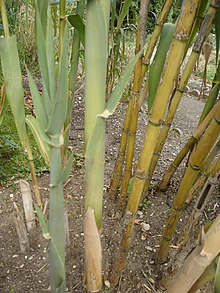
Arundo donax (future bassoon cane) growing in southern France


Thursday, December 19, 2013

Christmas Giveaway from The Bassoon Bureau

The Bassoon Bureau is a new online shop selling bassoon quartet arrangements as digital downloads.  In order to kickstart the business, owner Michael Grant of the U.K. is offering free downloads of 12 Christmas carols.  These arrangements are sight-readable and useful for bassoonists of all levels.  If you lack a library of bassoon quartets, this is a great way to start building one. 
 
I particularly like the fact that Michael Grant's bassoon quartets are designed to be played by 3 or 4 bassoons.  I'm always in favor of flexibility.  If one of your bassoon quartet members forgets about the gig or gets lost on the way, you're fine to proceed with three players.

Michael has arranged some well-known classics for bassoon quartet, including one of my all-time favorites, Henry Purcell's Rondeau from Abdelazar Suite.  Also featured is a tune commonly associated with bassoon, sCharles Gounod's Funeral March of the Marionette

Incidentally, Michael, who is also a clarinetist, has a blog with a great name: "Adventures in Woodwindland".  Be sure to check it out.

You can "like" The Bassoon Bureau" on Facebook:


Thank you, Michael, for your Christmas gift to the bassoon world, and good luck with your new online shop!


picture from The Bassoon Bureau website


.

Share this on Facebook
Tweet this


Wednesday, December 18, 2013

BasSOON It Will Be Christmas


Each year the Columbus Symphony performs three very popular Holiday Pops concerts with the Columbus Symphony Chorus and the Columbus Children's Chorus.  Conductor Ronald J. Jenkins also invites special guest artists each year such as dancers from BalletMet Academy and Wright State University, and there's always an appearance by Santa and Mrs. Claus.

placeholder
Columbus Symphony Holiday Pops performance
The production is always a crowd-pleaser, but Holiday Pops 2013 took the cake.  Why?  Well, this year Maestro Jenkins discovered a delightful piece to add to the program called BasSOON It Will Be Christmas by James Stephenson.  Columbus Symphony bassoonist Douglas Fisher and I performed the solo bassoon parts in front of the orchestra.
Photo: Bassoon It Will Be Christmas!
Columbus Symphony rehearsal of BasSOON It Will Be Christmas


James Stephenson
Chicago-based composer James Stephenson was a trumpeter in the Naples Philharmonic for 17 years before becoming a full-time composer.  He is currently Composer-in-Residence for the Lake Forest Symphony, and his works have been performed by the nation's leading orchestras.  BasSOON It Will Be Christmas is written for either two or three solo bassoons and orchestra.  Well-known Christmas carols are cleverly interwoven with major bassoon excerpts and the first movement of the Mozart Bassoon Concerto.  There's even a cadenza in which the opening of Tchaikowsky Symphony No. 6 makes an appearance.  Here is a recording of the entire work (3 bassoon version) from James Stephenson's website.  And here is a recording of the Columbus Symphony performing the 2 bassoon version.   The bassoons were not miked or amplified in the Columbus Symphony recording.

Not all excerpts are presented in original form.  Do you recognize the excerpt in the last line?

Ending of BasSOON It Will Be Christmas


 A few years ago the Jacksonville Symphony found a very imaginative way to offer holiday wishes to its fans featuring an excerpt from BasSOON It Will Be Christmas:


It's highly uncommon for bassoonists to be featured as soloists on pops concerts, much less on holiday pops concerts, but judging by the enthusiastic audience response, I'd say it's a worthwhile endeavor.  Thank you, James Stephenson, for composing this holiday gem, a welcome addition to our solo orchestral repertoire and thank you, Ron Jenkins, for featuring bassoons on this year's Holiday Pops!


Share this on Facebook
Tweet this
.