Thursday, March 29, 2012

Mozart Piano Concerto No. 24 in C minor, K. 491

Bassoonists are well aware of Mozart's incredible writing for our instrument.  His lovely bassoon concerto, written when he was 18 years old, takes the prize as the best-known work (by far) ever written for bassoon.  The bassoon parts of Mozart's wind serenades, symphonies and operas clearly show his extraordinary usage of the bassoon, and his late piano concertos perhaps offer the best examples of that.

Mozart composed K. 491 for himself to play in the Vienna concert series of 1784-6.  He was quite taken with the quality of the wind players in Vienna around that time and as a result, he assigned dramatic solo roles to the wind instruments rather than mere augmentation of the string parts which had been the tradition until that point in history.  In fact, some music critics have dubbed these concertos to be concertos for winds with piano obbligato!

I love the story about Beethoven, who upon first hearing Mozart's C minor concerto famously said "Ah, we shall never be able to do anything like this".  Beethoven's 3rd piano concerto, also in C minor, is clearly influenced by Mozart's K.491.


It's not uncommon for the winds to be moved to the front of the stage for these concertos so that projection and interaction with the piano are best enabled and the performance can be approached more like chamber music.  When the Columbus Symphony performed the Mozart Concerto No. 24 last week with Music Director Jean-Marie Zeitouni and soloist Stewart Gioodyear, the Ohio Theatre stage didn't allow for such flexibility; in fact, the winds were unusually far back from the front of the stage.

There are many, many exposed passages for bassoons in this concerto, so I will identify only the standouts.  In the slow movement, practically every note is exposed, and the 1st bassoon becomes particularly important in the passage for woodwinds beginning at measure 20:


The tempo can vary quite a bit in this movement.  Stewart Goodyear's tempo was on the fast side.  Still, I do not recommend trying to double-tongue the 32nds, even though the flute, which alternates 32nds with the bassoon, is likely to be double-tonguing.  I think it would be nearly impossible to achieve the clarity and tone quality required for Mozart if double-tonguing were to be used here.  (In other words, double tonguing is likely to sound too harsh.)  Also, it's important to match, and not over-balance, the flute on the 32nds.  It can be difficult to judge balance with the flute being in front of the bassoon, so the conductor is likely to assist with that determination.   Also, the conductor may ask for the bassoon to echo the flute on the 32nds.  This is challenging, since the notes in question tend to sound loud, especially when tongued in rapid succession.  It's unlikely that Mozart intended for the bassoon to sound like a machine gun in the midst of this tranquil, lyrical movement.

This is the second page of the Larghetto:


Each note on the page is exposed, which is part of the reason why the concerto is so much like chamber music, with the bassoon rising to higher levels of prominence in certain passages such as the one beginning at 70.  The type of reed I seek for this type of playing has reliable intonation on Bflats, the ability to taper well, and a pleasant, round sound.  

The lengthy eighth note passage of the third movement is one of the bassoonistic highlights of the piece:


I like to practice it all slurred, which is infinitely more difficult than playing it articulated.  Psychologically it's good to practice with a handicap so that performing the passage as printed seems like a breeze.  (Also, it's great for tongue-finger co-ordination to practice all slurred!)

Today's wind players are indebted to the Vienna wind players of the late 1700's.  If their playing hadn't impressed Mozart as it did, our orchestra repertoire would probably be missing some great gems.


.

Monday, March 5, 2012

A week with Nicholas McGegan

The last time  Nicholas McGegan  guest conducted the Columbus Symphony, there were no bassoon parts.  I knew I had really missed out, judging from the buzz amongst the musicians following that experience.

Well, this time around I was lucky.  Each piece on the program called for 2 bassoons:
Rameau: Selections from Dardanaus
J.C. Bach: Sinfonia Concertante in C Major for Flute, Oboe, Violin, and Cello, W C 343
Mozart: Chaconne from Idomeneo, K. 367
Haydn: Symphony No. 103 in E-Flat Major, Drumroll
McGegan, an advocate of early music and longtime Music Director of San Francisco's Philharmonia Baroque, has been called the sunniest conductor in classical music.  Indeed, he was absolutely beaming throughout his week in Columbus.  I'd go so far as to say that he's one of the sunniest human beings I've ever encountered.

The McGegan effect pervaded the orchestra.  Even the most glum among us began to lighten up and crack a smile now and then.  His humor was irresistible, as demonstrated by this McGegan quote about dining with composers from WOSU's Christopher Purdy's  blog post:
“Were I to invite composers to dinner at the same time, there are certain composers you really wouldn’t want at the table. Wagner would have been absolutely awful, he’d have only talked about himself. Bruckner probably would have prayed all the time, nothing wrong with that but you wouldn’t want it for dinner. Mozart would have been nice, he would have probably thrown bread rolls at the pretty girls, but that would have been okay. Mendelssohn would have been wonderful, and he could have answered your questions in any language. But Haydn would be the ultimate dinner guest. Handel of course would have just eaten your food as well as his, and Bach would have wanted more beer.”
Imagine those words spoken with a British accent, and you'll have a pretty good idea of the sort of entertainment the musicians enjoyed this past week.  One memorable story he told was of Haydn's wife - apparently the irreverent woman tore off pages from Haydn's scores to use as hair curlers!

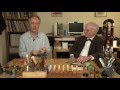
You can hear his accent for yourself in this impromptu interview by Columbus Symphony principal clarinetist David Thomas:


The orchestral parts had been carefully marked in advance by Maestro McGegan, which helped immensely in our efforts to summon the Baroque style using modern instruments.  None of the repertoire had been previously performed by the Columbus Symphony as far as I know, so we lacked the benefit of familiarity.  But McGegan's ultra expressive conducting left no doubt in our minds regarding what effect or nuance he was seeking at any given moment.  Sometimes, for example, he just shrugged his shoulders and waved us off with his hands, and we knew exactly what he wanted.  He even used appropriate facial expressions to help us keep track of confusing repeats and DCs, as if willing us to succeed!

Standards were high, and we were challenged, but we immensely enjoyed our Baroque adventure.  I definitely hope for bassoon parts the next time Nicholas McGegan comes to town.


.

Tuesday, February 21, 2012

Tchaikowsky Symphony No. 5

Last week the Columbus Symphony performed one of my all-time favorite works, Mahler Symphony No. 6, with our Music Director Jean-Marie Zeitouni.


I would prefer to continue wallowing in the aftermath of Mahler 6, allowing memories of its melodies to meander through my mind, but reality dictates that I must prepare for this week's performances of Tchaikowsky Symphony No. 5.  I find myself making comparisons between the 2 symphonies, each of which is considered to be the most personal work of its respective composer. 

But it's time for me to move on from Mahler and embrace Tchaikowsky.  After all, bassoonists are eternally grateful to any composer who favored the bassoon, right?  And Tchaikowsky is right up there near the top of the rather short list of such composers.  His 4th, 5th and 6th (and sometimes 2nd) symphonies appear on nearly every orchestral bassoon audition list.
“I should not wish symphonic works to come from my pen which
express nothing, and which consist of empty playing with chords,
rhythms and modulations… ought not a symphony – that is, the most
lyrical of all musical forms – express everything for which there are no
words, but which the soul wishes to express, and which requires to be
expressed?” - P. Tchaikowsky
 Tchaikowsky's inner turmoil is no doubt expressed in his 5th symphony, although it ends in bombastically optimistic triumph.  Tchaikowsky denied that this symphony was programmatic, but his initial sketches, jotted down during his lengthy period of self-doubt which preceded the writing of this symphony, hint at his original intent:
Introduction.
Complete resignation before Fate, or, which is the same,
before the inscrutable predestination of Providence.
Allegro.
(I) Murmurs, doubts, plaints, reproaches against XXX
(II) Shall I throw myself into the embraces of Faith???
It's generally accepted that his idée fixe, first presented by the unison clarinets in the introduction, represents fate in this symphony.  Beyond that, we can use our imaginations to figure out what Tchaikowsky's soul wished to express "for which there are no words".

There are many exposed bassoon passages throughout the symphony; I will focus on the main solos.  The 1sr clarinet and 1st bassoon play a soli in octaves at the beginning of the Allegro con anima of the 1st movement:


The top priority, I think, should be to successfully blend with the clarinet.  Using a reed which has the ability to taper note endings is ideal, to provide the degree of refinement necessary for this solo and the bassoon solo of the recap:


The articulations and a couple of the notes are different in this solo, although the hairpins are similar.  The bassoon playing alone in the recap is perhaps meant to sound lonely, wistful, melancholy, haunted.  For this solo and the earlier soli with clarinet, I try to play with a smooth, even and subdued sound.

In the Moderato con anima of the very famous second movement, the clarinet plays a solo followed by the bassoon.  To me, the clarinet solo always sounds soaring, and even though it's much more difficult to soar on the bassoon, that's my goal - to soar like the clarinet.


It's necessary to really put out for this solo just to match the clarinet.  I think it helps to have a well-focused sound.  In the second beat of measure 72, I practice it slowly in 3 groups of 3, tonguing the first of each group of 3 for clarity.  When actually playing it in the orchestra, it's likely that the bassoonist won't have the time or wherewithal to actually count the 9 notes.  I have found it helpful to practice it beforehand to the point where I can be sure that 9 notes are going to come out, even if I don't count.  This solo and the one at letter E can be played with rubato, such as stretching the notes with tenuto markings.  I practice with a metronome (at around 72 to the quarter) to be sure that any rubato is going to fit into a strict tempo.  Projection-wise, the solo at E is even more challenging to project than the solo before D.  Some bassoonist other than myself marked a breath at the end of the measure 2 after E, but I am not planning to breathe there - not unless the tempo is unusually slow..

And of course, the most famous bassoon solo of the symphony (and the one most likely to be asked at auditions is this one, in the third movement waltz:


The actual bassoon solo begins halfway through measure 56, but it's possible for an audition excerpt to begin at 4 after A and continue to measure 72.  Measure 19 is the beginning of the bassoon and oboe soli, which is an elegant dance.  At B, the bassoon joins the clarinets (be sure not to use any vibrato!) in yet another blending opportunity, leading up to the famous bassoon solo.

The first phrase (first 4 notes) of the solo is traditionally played slowly, out of tempo, in a dramatic declaration.  The second phrase is played subito p, either back in tempo or as part of a gradual return to tempo.  The downward slurred syncopated notes beginning in 78 may be awkward to play, but the goal is to not let that be known.  It should sound strong and easy.  I always practice this passage with the metronome set at many different tempos.  Even though I prefer to think of it in one, I set the metronome to 3 beats per measure at tempos ranging from 100 to 180.  As I've mentioned in previous posts, I like to practice with the metronome on the offbeats rather than the downbeats.  That method is particularly useful for this solo.  (Incidentally, the reason I have an orange sticker in measure 64 is so that my eyes will know where to go on the page after watching the conductor for the solo up to that point.)

Even though I have recorded this piece with the Columbus Symphony, I am sticking to my rule of preparing as if for the first time.

 TCHAIKOVSKY SYMPHONY NO. 5 SACD

Tomorrow we begin rehearsing Tchaikowsky Symphony No. 5 with guest conductor Gunther Herbig.  If you're in Columbus, come and hear the concert Friday or Saturday night at 8 in the Ohio Theatre!  And if you're not, you can hear the live broadcast at WOSU FM Classical 101 streaming audio.


,

Wednesday, February 1, 2012

Brahms Violin Concerto

Last week the Columbus Symphony performed the Brahms Violin Concerto with soloist Gil Shaham and our music director Jean-Marie Zeitouni. It was an amazing concert, as confirmed by the enthusiastic audience packed into the Southern Theatre in downtown Columbus.

It's important for bassoonists to focus on world-class musicianship as demonstrated by artists such as Gil Shaham, lest we allow the technical hurdles of our instrument to divert us from our primary goal.  Here's a stunning example of his playing:


What an honor it was to be onstage with such a musician!  In order to prepare, I sought a very smooth reed which played  pianissimo reliably.  Reeds like that also enable delicate attacks and tapers at the ends of notes.  These are the reeds I always prefer, actually, since they offer the player the most control.

The 1st movement requires a great deal of smooth, discreet and in tune playing from the 1st bassoon, as evidenced by the passages below:


For the dotted half F#s and C#s, it's a good idea to figure out the best fingerings for your chosen reed in advance.  I used my standard F#3 (LH: 2 + Eflat key; RH: 1+2+4) followed by the short C# (LH: 1+2+3+C# key+low D key) followed by alternate F# (with the right hand little finger F# key).  Intonation is the top priority, and smoothness is also important.  The eighths following the dotted halves are traditionally played with a tasteful bit of rubato, in the style of the piece. 

The bassoon enters with a smooth line in D major at the end of the violin cadenza:


In my experience, the tranquillo can be achieved only with a reed which allows it.  That's why I spend so much time seeking the right reed for a piece like this which requires such subtlety from the bassoon.  Also, this is one of those passages in which it's easy for the bassoon lag behind, because only the strings and the violin soloists are playing with the bassoon.  If the bassoonist relies on his/her ear, lagging behind is the probable result because of the physical distance between the strings and the bassoon.  At times like this, it's critical to watch the conductor.  (Light travels faster than sound!)

The slow movement's glorious wind writing features the 1st oboe as soloist.  The 2nd bassoon part commonly appears on 2nd bassoon audition lists as a test of intonation, control, and familiarity with repertoire.  The opening major third chord is played by 2 bassoons only and is traditionally played with a straight tone (no vibrato), especially since 2 horns later join the chord.  (As a general rule, all chords are best played without vibrato!)  The dynamics and hairpins can be exaggerated for maximum impact, but without ever overpowering the 1st oboe.

The 1st bassoon arpeggios beginning in measure 22 are open to interpretation.  Some conductors like them to be quite pianissimo; others like them brought out more. It's best to choose a middle-of-the road approach (not too hushed, yet not too outgoing) until the conductor weighs in.

In the last 2 measures of the Piu largemente above features a dialogue between the violin soloist and the 1st bassoon.  Again, that subtle and flexible reed which allows tapered note endings is a plus.

At the Poco piu presto in the 3rd movement shown below, the 1st bassoon and 1st clarinet enter with grace notes before the second beat after a very brief violin cadenza:


It's helpful to know that the orchestra is silent in the 1st beat of the Poco piu presto.  That's why I always listen to recordings of the pieces I'm about to perform, even if I think I know the piece.  It would be all too easy to forget about a detail like that, and it's not good to be caught off guard!


.

Monday, January 30, 2012

Prokofiev Symphony No. 4

Although Prokofiev himself favored his Symphony No. 4, apparently not everyone does - it  is rarely performed.  Prokofiev said that he liked this symphony for its "subdued tone and wealth of material".  (Believe me, its tone is not completely subdued!) Sergei Prokofiev, one of the 20th century's great composers (the greatest in some musicians' opinion), often infused his music with a dynamic, life-affirming character, and Symphony No. 4 is no exception, ending in a blaze of C major glory.  This very lyrical symphony, based upon Prokofiev's ballet The Prodigal Son, was substantially revised by Prokofiev in 1947, and it was this revision which the Columbus Symphony recently performed under the direction of guest conductor Rossen Milanov.

This symphony's 1st bassoon part is quite colorful and exposed.  The 4-note figures beginning at 12 in the 1st movement dovetail with the same notes in the second bassoon part.  This passage must be played with extreme smoothness and tranquility.  Then at 13, the 1st bassoon plays an unaccompanied solo, continuing the smooth, tranquil quality established earlier.


Prokofiev's bassoon parts are often unusual clef-wise, with treble clef making frequent appearances.  But check out the 3rd note in the measure 3 bars after 49:


Yes, that's a high E flat written in bass clef - we bassoonists rarely encounter high E flats, and we never encounter high E flats (also known as E flat 5) in bass clef (until now)!  This passage is with the horns and 2nd bassoon (an octave lower).

Another of the many exposed 1st bassoon passages begins the 3rd movement, in octaves with the 1st oboe:

Attention to detail is very important in this piece.  Maestro Milanov asked the oboe and bassoon to play this opening in a style which might be described as smooth and graceful, yet scherzando-like and full of character. 

Later in the movement there is another unaccompanied bassoon solo, beginning on high C (C5) written in bass clef:


I used the Bflat key fingering for F# (RH: 2 + E flat key; RH: 1 + 2 + Bflat key) because sometimes when playing with a full sound, it's too easy for the F# with my usual fingering (RH: 2 + Eflat key; RH: 1 + 2 + 4) to go sharp in pitch.  I also use the alternate F# key for the lower F# on the 2nd beat at 63.  I often use that fingering for its slightly darker tone and very slightly lower pitch.  Using the alternate F# key is a bit more challenging technically, but I use it so often that I'm used to it.

The 32nd note scale in the 3rd measure below really threw me off when I first looked at it, and I had a hard time trying to play it!  Then I realized that it was the enharmonic equivalent of an E flat major scale.  Oftentimes I jot down the key in the part to help with the execution of a tricky passage, but in this case the enharmonic equivalent was more useful than the original key, for sure.


The passage at 8 measures after 70 is another unaccompanied bassoon solo:


This solo is best played very legato, with a full sound, watching the conductor for the huge slowdown (with diminuendo) into 71.

There were mistakes in my part in the following exposed passages, so if you play this piece, check your part for note mistakes.  The 1st section, before 90, is with the 1st flute and the next section is with the 1st oboe.  These passages are finger twisters:


It takes a certain kind of reed to pull of the following sarcastic bassoon solo in the 4th movement (it's in 2 beats per measure, or one beat per measure for 2/4 or 3/4):


It really has to be played forte and should sound like a taunting, bratty child!   I chose a reed that had a really strong and reliable high C.  It has to cut through the orchestra.  The mocking bassoon outburst continues a few bars later, in B flat major and c minor.

I would say that Prokofiev had a vividly imaginative approach to his bassoon writing, especially in this symphony, and I am glad to have had the opportunity to perform it.


.


Saturday, January 14, 2012

Brahms-Schoenberg Piano Quartet Op.25 arranged for Orchestra


The Brahms-Schoenberg Piano Quartet, Op.25 arranged for Orchestra was performed last week by the Columbus Symphony with guest conductor Matthias Bamert.  As soon as our recording is available, I'll post in here for the benefit of anyone unfamiliar with this magnificent work (which has been referred to as Brahms' 5th symphony!). 

To answer the question of why he orchestrated the Brahms Piano Quartet, Op. 25 for large orchestra, Schoenberg wrote:

"My reasons: I like the piece.
It is seldom played.
It is always very badly played, because, the better the pianist, the louder he plays and you hear nothing from the strings. I wanted once to hear everything, and this I achieved.
My intentions: to remain strictly in the style of Brahms and not to go farther than he himself would have gone if he lived today.
To watch carefully all the laws to which Brahms obeyed and not to violate them, which are only known to musicians educated in his environment."

(Letter to Alfred Frankenstein, San Francisco Chronicle, March 1939)

Maestro Bamert explained to the orchestra that Schoenberg orchestrated the piece the way he believed Brahms would have at the time (1937), given the more advanced methods and trends of orchestration.  According to reports from the audience, the piece was every bit as captivating from out in the hall as it was onstage.

The 1st bassoon part features some of the most difficult passages I've ever encountered.  This one beginning in measure 454 of the second movement is an example:

The movement is in a moderately fast 3 beats per measure.  The.high B grace note is problematic - in fact, without the high B grace notes, the passage would be easily playable.  Bassoons vary somewhat in the placement of the left thumb keys.  On my bassoon, the high B (C) key is a bit farther away from the whisper key than I'd like.  That's typical of newer Heckels.  It may seem that an obvious solution is to leave the thumb off the whisper key for the G which precedes the high B. (The high G still plays without the whisper key.)  However, that doesn't help as much as one would expect.   It only confuses the left thumb because of its prior programming!  For me, the odds of nailing the high B grace note did not seem to be increased by eliminating the whisper key on G.

The first flute also plays the passage, an octave higher, and for reasons unclear to me, it always seems difficult to tune passages written this way (with the bassoon in the high range and the flute an octave higher).  The high A was particularly difficult to tune with the flute in my case.  In the orchestra, it is much easier to hear instruments (or voices) behind you than those in front of you.  Also, in general, the higher instruments in the wind section tune to the lower instruments.  For those reasons, the majority of the burden for tuning this passages falls on the flute player's shoulders.  It often helps to have a chat about that so that the flute player knows that you are counting on him/her to tune to you.  I always like to reassure the player that I will do everything I can to play each note in tune so as to ease the tuning burden. 

Suffice it to say that this passage was nerve-racking despite lots of slow practicing.  I strongly recommend cleaning out the bocal before playing this piece.  (That helps with reliability of the high notes.) 

Another great challenge begins in bar 618, in movement III:


It's in 3, and although the tempo is not terribly fast, it's fast enough to cause great concern for the first and second bassoonists.  The other woodwinds are involved, but only the bassoons play in this octave.  Although these 32nd notes are mostly lost in the orchestral texture, it is our goal to fulfill the composer's wishes, even when doing so is nearly impossible.

The 4th movement is perhaps most frustrating of all, bassoon-wise.  Check out the 3 measure beginning at 856:


The tempo is fast (presto!).  It may be possible to single tongue (for bassoonists with really fast single tongues) but I recommend preparing to double tongue.  That way you'll be ready for any tempo and won't have to worry about switching back and forth between single and double.  Ideally, a good double tongue cannot be distinguished from a single tongue anyway, so there's no reason not to double tongue.  But first, this passage is best practiced all slurred, slowly at first, gradually increasing the tempo, to make sure that the fingers are totally and reliably even. 

It is not reasonable for the left thumb to depress the whisper key for the high Gs or G#s in this passage.  The left thumb, which has been programmed to depress the whisper key for high G and G#, just has to be re-programmed for this passage, through much repetition.  I also use the short F# fingering (LH: half hole, 2,3 + Eflat key; RH: 1).  This passage is exposed!

So is this one:


Comparatively, this one is a lot easier, that is, until measure 873 arrives with its entanglement of fingerings for G, F and Eflat.  This longer passage really benefits from double tonging.  Even if one is able to single tongue at the conductor's chosen tempo for this movement, I believe it is necessary to double tongue for the sake of velocity.  Single-tonguing is too likely to become bogged down.

The following passage beginning at 1078 is doubled in the second bassoon part.  The high Bflats in this passage make things interesting.  Maybe Schoenberg added the second bassoon to this to increase the odds successful execution (I'm not sure):


This masterpiece (Brahms Symphony No. 5!) is wonderful to listen to, and performing it is quite an adventure.  I think that most bassoonists would agree that the massive challenges are worth dealing with in exchange for the opportunity to play the Brahms-Schoenberg Piano Quartet, Op. 25 arranged for Orchestra.


.

Tuesday, December 20, 2011

Nutcracker 2011

                                                                     
Slide
Ever since the mid 1900s The Nutcracker ballet has been a beloved holiday tradition in many U.S. cities.  Here in Columbus we are fortunate that BalletMet uses the Columbus Symphony to provide live music for its Nutcrackers. 

The Nutcracker score features some of Tchaikovsky's best known melodies.  Perhaps because the music is so recognizable, once in a while someone asks how we manage to play the same music over and over.  Isn't boredom a problem?

Well, from a bassoonist's perspective, The Nutcracker is anything but boring.  There is a challenge at every turn, it seems.  The most difficult passage in the 1st bassoon part is this one (the tempo is around 120 per dotted quarter):


 The second most difficult passage, in my opinion, is this perennial nail-biter:
                    
                                     
I'm not sure how many times I've played The Nutcracker (check out Columbus Symphony horn player Julia Rose's blog post in which she writes about playing her 200th Nutcracker!) but no matter how many times I play it, these passages will require extra attention.

To improve the accuracy of the first passage above, all we can do is apply the usual set of practice techniques.  Slow it down and take out the articulation (play it all slurred, which is really awkward).  Then apply different rhythms (also very awkward).  I also like to practice the triplets in a duple rhythm.  By the time you have perfected all of that, the original passage seems easy!  But don't be lured into complacency.  It has to be practiced constantly.

The second passage features the high A to B trill.  The bassoonist's first job is to figure out which trill fingering brings the best results.  For me, it's this fingering, with the low E flat key depressed:


I have tried various fingerings for this A to B trill, and this one has brought the best results by far.  For The Nutcracker I use a reed which favors the high register because of this solo.  (Obviously the reed still has to have a halfway decent low range also, due to numerous exposed low passages.)

Getting back to the question of boredom, there is another answer to that question which has nothing to do with the bassoon part, and everything to do with the mission of the musician.  It is our responsibility to serve the composer, the music, the dancers or soloists as applicable, and the audience to the best of our abilities in each and every performance.  That's very daunting, and not at all boring!

The musicians of the Columbus Symphony are grateful to be performing with BalletMet, especially now, considering that arts organizations across the country are struggling to make ends meet.  One of the BalletMet dancers told one of the musicians that the dancers are thrilled to perform with the Columbus Symphony.   She explained how the energy from the live music inspires the dancers.  I know how that works, because every once in a while we have dancers performing at the front of the stage where we can see them, such as during our Holiday Pops concerts, and we derive inspiration from the dancers.  The beauty of each of the two art forms is enhanced by the collaboration. 

If you live in Columbus and haven't yet attended this year's Nutcracker, there are several performances taking place this week:

Tues, 12/20, 7:30pm
Weds, 12/21, 7:30pm
Thurs, 12/22, 7:30pm
Fri, 12/23, 2pm
Fri. 12/23, 7:30pm
Sat, 12/24, 1pm

You can buy tickets here.  Hope to see you there!

.