Friday, July 29, 2011

L'Histoire du Soldat

In 1918 Igor Stravinsky, who was living in Switzerland at the time, collaborated with Swiss writer C.F. Gamuz to create L'Histoire du Soldat (The Soldier's Tale) which was meant "to be read, played and danced."   The story is about a soldier (whose soul is represented by the violin) making a deal with the devil (the percussion).  Stravinsky and Gamuz wanted to put together a "portable" production which would be easy to tour with, so the instrumentation was limited to a septet (violin, clarinet, trumpet, string bass, bassoon, trombone and percussion).  They also planned to augment the production with a handful of characters who would narrate, act or dance.

Stravinsky had not yet heard jazz, but Gamuz had.  In fact, Gamuz had brought back some jazz scores from a visit to the U.S., and Stravinsky used jazz influences for the first time, along with frequent meter changes, in L'Histoire. Apparently the bassoon is substituting for the more jazz-oriented saxophone in L'Histoire.  (Rumor has it that Stravinsky did not care for the saxophone, luckily for those of us who play the bassoon!)

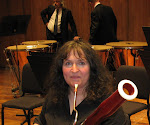
Along with several other Columbus Symphony musicians, I had the good fortune to participate in two presentations of L'Histoire recently.  Columbus Symphony violinist Olev Viro organized and conducted the performances.  One of the performances took place in Yellow Springs, Ohio, with an acting troupe from that area who used the Kurt Vonegut libretto.  The other, using the standard libretto, was presented in Columbus using dancers from The Ohio State University and local narrators.

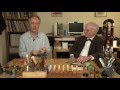
The following video, based upon our Columbus performance with OSU dancers, was produced by WOSU Public Media Art Zine:


For any bassoonist encountering L'Histoire for the first time, I have three words of advice: Music Minus One.

STRAVINSKY L'Histoire du Soldat (septet)


I owned this Music Minus One when I was in high school, and back then I spent quite a bit of time playing along with the recording just for fun.  Music Minus One can also be really helpful in actually preparing for a performance.  Stravinsky's bassoon parts are always challenging, and this practice aid is most welcome.  L'Histoire's specific challenges include tricky meter changes, technical passages, and intonation with the clarinet in the Pastorale movement (which can be heard toward the end of the above video).  Although L'Histoire is a septet, it has shown up on orchestral bassoon audition lists.


This is the bassoon part for Music for Scene 2, "Pastorale":


It's important to have the right reed for this.  The reed has be reliable on high C# and on delicate attacks of each note.  When I played this movement all of my focus was on the clarinet part - specifically, the intonation of the clarinet.  It helps to be sure of one's own intonation in this movement before the first rehearsal, and then, during rehearsals and concerts, to be flexible in tuning to the clarient.  Watch out for the extensive passages involving only two notes, high F# and high G#, in the bassoon part, such as from number 6 to the end.  It's not simply a matter of changing from one note to the next at the right time; each note has to lock in, intonation-wise, to the clarinet line, and that requires ultra-careful listening and flexing.

The Marche Royale movement has a couple of tricky passages:


Placing each eighth note on the correct beat or half beat is the first goal.  Secondly, the exposed passage beginning 3 measures before number 4 can be a finger-twister unless the tempo is unusually slow.  (Stravinsky was thoughtful enough to write in the tempo markings, though...)  As with any finger-twister, it must be practiced in a slow and relaxed fashion until the fingerings are automatic (and accurate!).

This is also from the Marche Royale movement:


A quick glance at the above excerpt show how important it is to have a rock-solid steadiness of eighth notes throughout.  Otherwise, the chances of derailing are high.  The bassoon solo at number 9 is an example of a passage where the bassoonist must be rhythmically reliable and unwavering.  Four measures after 11, the bassoon is in unison with the trumpet.  My policy regarding intonation in unison passages is that the louder (or loudest) instrument rules.  Since pretty much every instrument is louder than the bassoon, I am usually forced to  follow rather than lead in such passages.  But learning to accurately match another player is a skill worth developing.  All it requires is the willingness to listen, and then flex accordingly.

To me, the Ragtime is the most difficult movement for bassoon:


With Stravinsky's tempo of 192 to the eighth and constant meter changes, this movement can easily end up being a "ragged" ragtime!  The measure at 27 is, in my opinion, the most technically difficult measure of the entire bassoon part:


It is not practical to attempt to use standard fingerings to execute the first three notes of the quintuplet in the 4th beat of the measure.  This is the fingering which worked best for me for high A and B:


The Danse du Diable (Devil's Dance) movement moves along at a fast clip (138 to the quarter):


The 16ths can be single- or double-tongued, but I found that double-tonguing seemed to fit better.  (The last thing the bassoonist should do here is become bogged down with a single tongue which can't quite keep up.) Marked ff, the 16th note passages must be played aggressively.  But be ready to play sweet-sounding eighth notes in the high range at number 2 and beginning 3 before number 3.  No question, Stravinsky knew how to put the bassoon to good use!

.

Saturday, July 23, 2011

How to circular breathe

Here's all you need to begin learning to circular breathe:
Puff out your cheeks, filling them with air.  Then blow into the straw, making bubbles in the water:
When you need a breath, just expel that air from your cheeks into the straw while you simultaneously inhale through your nose.  The goal is to sustain the bubbles continuously.  If it works, then congratulations - you're circular breathing!  (It might help to practice forcing that cheek air out into the straw a few times, creating bubbles in the water by just expelling cheek air, NOT by actually breathing, to get used to the technique.)

That's how I learned to circular breathe.  I recall that it was fairly easy to progress to the point where I could sustain constant bubbling.  Eventually, when you do this on the bassoon, the goal will be to sustain the flow of air into the bassoon while transitioning from circular to regular breathing.  Just keep remembering those bubbles.  It's easier to transition with the bubbles in the water than it will be with the air in the bassoon.

The level of difficulty in circular breathing varies from instrument to instrument. I am guessing that it is relatively easy on the clarinet judging by the preponderance of YouTube videos featuring clarinetists circular breathing. Here's an outstanding video of Michael Norsworthy explaining how to circular breathe:


Any bassoonist trying circular breathing on the bassoon for the first time will undoubtedly wonder how the technique could possibly be useful.  Intonation goes completely out the window!  In fact, because of that, I was very discouraged about my own ability to circular breathe usefully.  Now, thanks to the many clarinetists, oboists and didgeridoo players offering instructive videos, I have learned that it often takes years to learn to circular breathe well, so I'm practicing circular breathing again, with renewed enthusiasm.  (Summer pops concerts are good for that!)

Is circular breathing necessary?  Well, many bassoonists believe that circular breathing is necessary for playing Bach, for example, and circular breathing is actually called for in some contemporary pieces.  Decades ago, techniques like flutter tonguing, double tonguing and circular breathing used to be rare parlor tricks.  Now they're all necessary aspects of our technique!

My teacher, K. David Van Hoesen presented a recital a few years ago at the IDRS Conference at Ithaca College.  I was struck by the incredible ease of his breathing, and how his breathing never once interfered with his graceful phrasing.  I mentioned that to him after the recital.  Much to my shock, he said that he had circular breathed throughout the performance due to an injury to his ribs from chopping wood.  In other words, he played an entire recital by expelling air out with his cheeks while sniffing air through his nose!  Any bassoonist who is unsure of the merits of circular breathing should have heard that performance.  It was stunning!


.

Wednesday, June 22, 2011

Berlin Philharmonic auditions

A couple of years ago, the orchestra musician forum polyphonic.org  featured a virtual discussion panel entitled "Auditioning the Audion Process."   Many readers were fascinated to find out how musicians audition for the Berlin Philharmonic, as explained by Berlin Philharmonic hornist Fergus McWilliam: 


"Since its founding in 1882 the Berlin Philharmonic has enjoyed three critical and inextricably related advantages, when it comes to auditioning new musicians. None of these is, or should be, unique in the orchestral world, however the combination is uniquely powerful and effective for us.

1. The vacancy belongs to the orchestra. In no way is it the property of the public domain. The orchestra is not obligated to fill a position once it has been advertised and we reserve the right not to select anyone at an audition. In my time we have more than once taken over eight years to find the right person.

2. We, the members, know pretty well what we are looking/listening for:
we know our collective sound, our musical language, our collective artistic personality. The audition is not therefore primarily a contest between competitors for a gold medal. Much more importantly, we search for the "right" musician, not necessarily only the "best" player.

3. The orchestra decides who is chosen - all musician-members vote on the basis of one musician - one vote. Neither a select audition committee, nor principal players, nor the concerned section and certainly not the conductor controls the audition decision. Tenure is also granted by the orchestra membership alone, based on a secret vote.

Audition Repertoire:

We emphasise solo repertoire, not orchestral excerpts at the audition. If a Mozart concerto exists for the instrument being auditioned then that is mandatory. Otherwise another classical period concerto is expected. Invariably we ask at least for the 1st movement with a cadenza; in a second round a contrasting work of the candidate's choosing. Orchestra excerpts are never requested at violin, viola and cello auditions. For double bass, the winds and brass yes.

We look for strong personalities, powerful musical statements, individual interpretations, in addition to beauty of tone, stylistic knowledge, technical skill, etc. The concerto is the centre of the audition, not just a warm-up piece.

Audition procedure:

The section with the vacancy reviews all applications and democratically selects between 10 and 16 candidates who will be invited to an audition in front of the orchestra. If a high number of qualified candidates makes it necessary, a pre-audition may be held the day before. This is open to the whole orchestra but is not mandatory; usually only the concerned section is out in force.

No screens are used. We want to learn as much as we possibly can about the candidate in the short time they are on stage. One can "see" a lot by observing body language and stage presence.

We have frequently used a kind of "shoot-out" procedure at winds and brass auditions. Typically two to four "finalists" are on stage together and we have them perform excerpts in each other's presence. Although this is a brutally effective way of testing the candidates' nerves, more importantly it is also an extremely effective way for us to compare and contrast, with profound immediacy, the sounds and approaches of similarly qualified candidates.

The music director is free to attend if he wishes, and is granted a single vote like every one else.

Probation:


Can last one to two years, after which the concerned section makes a recommendation to the whole orchestra. The final decision is however made in a secret ballot of the orchestra membership. This is the most testing time for a new player and in the recent past fully one third of the probationary musicians were not accepted into the orchestra. This the time when, if necessary, we must fix any hiring mistakes WE may have made!"

Several aspects of the Berlin audition procedure caught my attention.  First of all, the typical audition in Berlin, instead of resembling a cattle call, features 10-16 audition candidates who are evaluated by the entire orchestra!  (This is the complete opposite of the typical U.S.audition which features many, many candidates who are judged by a tiny committee.)  The Berlin Philharmonic emphasizes solo repertoire, not orchestral excerpts in its auditions.  (It's about how the musician plays rather than how much time the musician has spent obsessing over a few isolated orchestral passages taken out of context!)  But to me, most intriguing of all is the Berlin Philharmonic "shoot out":

"We have frequently used a kind of "shoot-out" procedure at winds and brass auditions. Typically two to four "finalists" are on stage together and we have them perform excerpts in each other's presence. Although this is a brutally effective way of testing the candidates' nerves, more importantly it is also an extremely effective way for us to compare and contrast, with profound immediacy, the sounds and approaches of similarly qualified candidates."

Yes, at first glance, this may seem brutal.  But it's not that different from performing orchestral solos within the orchestra, surrounded by one's colleagues, including those who play the same instrument.....and it's a situation commonly faced by college students whose professors insist on regular performance in front of peers.  Summer music camps like Interlochen feature weekly challenges in front of peers.

I think the "shoot-out" makes great sense.  When I was a student at the School of Orchestral Studies during high school, the Philadelphia Orchestra's then principal bassoonist Bernard Garfield arranged for the 5 bassoon students to audition "shoot-out" style to determine which one of us would play 1st bassoon on Mahler Symphony No.1.  Mr.Garfield was unable to attend the shoot-out, but there was a panel of judges in place as we each played the 3rd movement solo in front of one another.  (Guess who won?)

The audition committee surely benefits from the shoot-out, since it makes back-to-back comparisons possible.  It's in everyone's best interests for the audition committee to have maximum information to increase the likelihood that a sound and lasting decision can be made.


.

Thursday, June 16, 2011

Orchestral auditions

In order to obtain a position in a professional orchestra, a musician must win an audition.   For the benefit of any reader who doesn't know what goes on during an orchestral audition, here's a summary of a typical audition from start to finish:

First, the orchestra publishes an advertisement for its open position in the musicians' union monthly, The International Musician, which is mailed to each member of the American Federation of Musicians throughout the U.S. and Canada.  Orchestral job openings are also posted online on websites such as myauditions.com.

The frequency of job openings varies from instrument to instrument.  Since every orchestra hires more full time violinists than any other instrument, obviously violin openings are the most common.  It's not hard to imagine that each month, there are at least a couple of violin openings advertised. For non-string instruments, openings are less frequent.  Harp and tuba openings are rare, and I'm sure that some years there are no openings at all for those instruments.  Orchestras hire 2, 3 or 4 full time bassoonists.  Some months, there are no bassoon openings.  Also, many wind players are interested in specific positions.  For example, if a bassoon player really wants to play principal, he or she may have to wait for months before there's a principal opening anywhere. 

As soon as the job is advertised, applicants immediately mail or email resumes to the orchestra's personnel manager.  Most orchestras also require a deposit check of $50 or $100 to be returned when the candidate shows up at the audition, which is usually held 2 or 3 months after the advertisement is published.

After submitting a resume to the personnel manager of the orchestra, each applicant is presented with a list of pieces to prepare for the audition.  Audition lists often feature a couple of different solo pieces or concertos plus a list of 15 or so orchestral works (sometimes more, sometimes fewer).  At the end of the list there is usually a statement that sight-reading may be required (which means that the candidate may be asked to play unexpected works sight-unseen).

Musicians preparing for an audition have to practice a lot, since the goal is to perfect the entire list.  Any musician who already has a job or other responsibilities is especially challenged by the task at hand.

Audition candidates travel at their own expense to the site of the audition (usually the hall where the orchestra performs).  Upon arrival at the audition site each applicant is given a number (as a result of drawing numbers out of a hat or a similar method).  Based upon that number, each candidate is offered an approximate time for his or her preliminary audition.  That time might be several hours later, and the candidates often wait in a large public room (where they may warm up if they choose, but not without the secret scrutiny of their competitors!) until anywhere from 10 to 30 minutes before their audition, when each candidate is assigned a private warm-up room.

The preliminaries are nearly always held behind a screen, and each candidate plays for less than 10 minutes.  Usually 4 to 6 short excerpts are heard in the preliminaries.  The orchestra's personnel manager may or may not tell the candidates when they check in what those excerpts will be, depending upon that orchestra's policy as outlined in its Collective Bargaining Agreement..

For the preliminary audition, each candidate in turn walks down a walkway, usually carpeted to mask sounds, to the chair and stand set up for the audition.  A large screen looms ominously in front of the musician, and a mysterious voice from behind the screen instructs the candidate to begin. 

Undoubtedly, many candidates engage in a mental exploration of the unseen committee:  How bored are they?  Do they want me to hurry up and get through the excerpts, or does that expose my lack of experience?  Should I play a few notes to test the acoustics, or will that put off the committee?

Some musicians find performing in an orchestral audition to be unnatural, and unrelated to the actual task of playing in an orchestra.  In the orchestra, the music prevails, and any solo which a musician plays from within the orchestra is simply a part of a much larger context.  It is easy for an orchestra member to be caught up in the music, and self-consciousness falls by the wayside as each musician accepts his/her role as a member of a music-producing team.  Not so during an audition!

Another common complaint about auditions has to do with audition repertoire. On the job, musicians know exactly which pieces will be performed each week (and even during each rehearsal!), and the number of pieces to be performed is reasonable.  There are no surprises.  Yet during an audition, the element of surprise is constant, since the candidates don't know until the last minute exactly which excerpts from which works will be asked.  Sight-reading is on nearly every audition list, and it means that any piece of music ever written can be placed in front of the candidate.  The prepared audition list is long - much longer than the list of pieces that an orchestra member would be expected to perform in one day!

Additionally, during an audition it is difficult to assess a candidate's sense of ensemble and ability to follow the conductor.  For principal positions, leadership skills are untested during the audition process.

After playing a preliminary round, the candidates wait in a designated waiting room for results.  Results are typically announced each hour or so, but the wait seems interminable.  Candidates chat among themselves; many know each other from previous auditions.  (Regulars are said to be "on the audition circuit".)  Finally the personnel manager or assistant appears, and most candidates are sent on their way; the lucky ones are asked to stay for semi-finals.

The semi-finals are usually held behind a screen as well, and the list of excerpts is usually longer than the preliminary list.  After that round, some candidates are thanked and sent on their way, while the luckiest stay for the finals (assuming that musicians who succeed at auditions are talented, prepared, and lucky!)

Finals are almost always held with no screen, thus enabling interaction between the audition committee (which always includes the Music Director for the finals) and the candidate.  A finalist may be asked questions about his/her equipment or background, or he/she may be asked to play things differently (faster, slower, more pianissimo, with more freedom, etc.)  Candidates often play for considerable lengths of time in the finals, which is why endurance is such an important factor in audition preparation.  There may even be yet another round.

Some orchestras, including the Columbus Symphony, carry the audition process a step further by occasionally asking a finalist to perform within the orchestra.  That makes a lot of sense to me, since actually performing in the orchestra is so vastly different from playing an audition.

Sometimes there is a winner at the conclusion of an audition; sometimes not.  The audition process is far from perfect, for sure.

Is there a better way to test musicians for employment in an orchestra?  I recall hearing a story about a legendary bassoonist winning an audition for the NBC Symphony during the mid 1900s by playing a Bb minor scale - nothing more, nothing less -  for conductor Arturo Toscanini.  Is that a preferable method of sorting out orchestral candidates?  (That bassoonist really did deserve the job, by the way!)
Arturo Toscanini

My next post will explore the Berlin Philharmonic's audition procedure, which is very, very different from what I've described here.


.

Tuesday, June 7, 2011

Some orchestras' secrets of success

 It's rare these days to read good news about symphony orchestras, so today's report of record-breaking support for the Houston Symphony was indeed welcome.

The Houston Symphony adopted an ambitious five-year plan covering fiscal years 2011 through 2015 to strengthen its financial position. At its core, the plan focuses on the need to expand the Symphony’s audience and donor bases through strategies such as: 
  • introducing satellite concert series throughout Greater Houston
  • investing in new concert formats and multi-media projects
  • building stronger ties between patrons and the organization.
The successful FY11 outcome in Houston was largely the result of two factors:
  • the extraordinary generosity of the Symphony’s Board of Trustees who collectively doubled their annual contributions
  • more than 1,200 donors who made made first-time gifts to the Annual Fund during a “Million Reasons to Give” campaign
Wouldn't it be nice if Houston's solution could be applied to any orchestra suffering from financial challenges?  Of course, it's not that simple.  Each orchestra exists within a unique set of conditions.

For starters, orchestras' budgets vary greatly.  The Houston Symphony's annual budget for fiscal year 2011 was $25 million.  During the 2010-11 season, annual budgets of full-time orchestras ranged from $98 million for the Los Angeles Philharmonic to $6.5 million for the San Antonio Symphony.

"It costs money to make money."

Houston's fairly hefty budget allows for the above-mentioned satellite concert series throughout Greater Houston area as well as the multi-media projects.  I'm sure that any beleaguered orchestra would be thrilled to incorporate such concerts, but how many can afford to?

Another orchestra which has recently heralded good news financially is the Colorado Symphony.

To explain the Colorado Symphony's standout success at the box office, symphony leaders point to: 
  • more accessible programming, especially the introduction of its multimedia Inside the Score series
  • an overhaul of its marketing
Colorado's Inside the Score concerts are informal, multimedia programs which diverge from a straight concert format with the addition of light commentary and the frequent participation of dancers, actors and other collaborators.  Examples this year have included an exploration of tango, a breakdown of Dvorák's "New World" Symphony and a CSI investigation of the ailments that killed Beethoven, complete with an actor portraying the famed composer.  

The most recent Inside the Score concert on April 1 was devoted to a radio- style countdown of classical music's top 10 most popular works. More than 1,600 people attended, including 1,000 who purchased their tickets through a Groupon promotion.

"It makes a better use of our orchestra and the space, and (it has) turned a new product into a whole new interest," said Margaret Williams, vice president of marketing and communication. "We now have full halls, whereas it had been very small audiences in the past. We couldn't sustain 21 Masterworks concerts on Friday nights."

The Columbus Symphony Orchestra performed a similar type of concert last season, called Beyond the Score® .  It was extremely well done and entertaining, but the production, owned and rented out by the Chicago Symphony, was expensive.  (The fee covers such aspects of the production as orchestral parts with excerpts for demos, scripts for narrators, and video.)  Unfortunately, Columbus has no more of those concerts planned for the future due to the cost.  It appears that the Colorado Symphony, recognizing the limits of its modest $10 million budget, decided to  produce its own series patterned after Chicago's Beyond the Score® series.  (Smart move, Colorado.) 

Almost a third of all audience members in Denver are new ticket buyers!  What attracted more first time concert-goers to Denver's Boettcher Concert Hall this year??  According to symphony officials, these are some of the changes which attracted new audiences:
  • new investments in marketing and technology 
  • a new website
  • a social media campaign
“The Colorado Symphony undertook a complete overhaul of sales and marketing programs at the same time that it examined what Denver communities want and need from a symphony organization,” said James Palermo, the symphony's president and chief executive. “We asked tough questions, such as whether programming has sufficient appeal to younger generations and if people still want two-hour concerts.

“We also conducted research to learn more about what young families in Denver desire in terms of family programming, as well as what educators need from our music education programs. The results include not only the new Inside the Score series, but across-the-board changes to everything we offer and how the Colorado Symphony does business on a daily basis.”

Fundraising and development also improved. The number of individuals donating to the Colorado Symphony’s Annual Fund has doubled in the last 18 months.

Read more: Colorado Symphony on track for record ticket sales | Denver Business Journal

What do Denver and Houston have in common?   Location, location, location.  Both cities happen to be located in currently fast-growing states.  Denver boasts the additional advantage of being the only full-time professional orchestra in its state.

Factors such as location cannot be controlled for the most part (although the Cleveland Orchestra has found creative ways to deal with the location problem, as exemplified by its winter residency in Miami).   But I think that the Houston Symphony and the Colorado Symphony (notably with its thorough examination of what its community wanted) have provided fine examples for other orchestras of how to wisely spend money to make money, within the limits of their budgets.

.

Sunday, May 29, 2011

Do Musicians have Better Brains?

Apparently they do.  According to a recent post on Freakonomics blog, musicians' brains are rather highly developed!  Check it out:

(Photo: Lifesize)
A new study (abstract here; summary here) argues that musicians have more highly developed brains than the rest of us. The research relates the concept of high mind development to the potential to become really good at something:
New research shows that musicians’ brains are highly developed in a way that makes the musicians alert, interested in learning, disposed to see the whole picture, calm, and playful. The same traits have previously been found among world-class athletes, top-level managers, and individuals who practice transcendental meditation.
Using EEG‘s to measure brain activity, researchers concluded the following about the brains of musicians:
They have well-coordinated frontal lobes. Our frontal lobes are what we use for higher brain functions, such as planning and logical thinking. Another characteristic is that activity at a certain frequency, so-called alpha waves, dominates. Alpha waves occur when the brain puts together details into wholes. Yet another EEG measure shows that individuals with high mind brain development use their brain resources economically. They are alert and ready for action when it is functional to be so, but they are relaxed and adopt a wait-and-see attitude when that is functional.

*******************************************************************************

The original article in Science Daily also states the following:

Two questionnaires are also used to measure mind brain development. One has to do with moral reasoning. Those with high mind brain development score higher here. The other questionnaire targets what are called peak experiences. These are described as a higher level of consciousness. You have an intense feeling of happiness and harmony and of transcending limitations. Individuals with high mind brain development have many peak experiences.

 Fred Travis emphasizes that everything we do changes our brain. Transcendental meditation and making music are activities people should devote themselves to if they wish to change their mind in the right direction. But you can make good progress by following common health recommendations: get enough sleep, work out physically, eat healthily, and don't do drugs. How you think also plays a role.

 "If you are a very envious, angry, mean person and that's the way you think about people that's what's going to be strengthened in your brain. But if you are very expanded and open and supportive of others, there will be different connections," says Fred Travis.

Just imagine the brainpower of an open, supportive, health-conscious musician who practices transcendental meditation!  And how about those former musicians who are now orchestra administrators - their brain activity measurements must be off the charts........

.