Friday, December 25, 2009

The reed making habit

One of the benefits of maintaining this blog is that I am under constant self-induced pressure to practice what I preach.  I have preached that reed making is a habit which must be practiced daily to hone one's reedmaking skills and to provide a plentiful supply of reeds to choose from.  I stated that my goal was to make a minimum of one reed per day.  That goal seemed reasonable and worthwhile.

My longtime habit was thrown off by a change in scheduling of the Dr. Phil show.  Until recently, the Dr. Phil show aired daily at 10am, which proved to be the ideal time of day for me to make reeds (as long as I didn't have a 10am rehearsal).  In October Dr. Phil was moved to a late afternoon slot, and for some inexplicable reason, I can't/won't make reeds late in the day.


Dr. Phil had provided the perfect backdrop for reedmaking, because it was unnecessary to look at the TV screen- I just listened.  And learned.  (An added benefit of the Dr. Phil backdrop was that I was able to use my new found counseling skills to help troubled friends and acquaintances.  It's amazing how many problems can be dissipated by merely asking the famous Dr. Phil question: "So how's that workin' for ya?")


Glancing at the reed rack, I realized that the blanks on that rack had been formed weeks ago.  I had entered into a full-fledged reed slump.  I can't totally blame Dr. Phil for that.  These days, it's more important than ever before for orchestral musicians to do whatever they can to help the orchestra.  Here in Columbus we volunteer in various ways, such as playing for fundraisers and serving on committees.  Right now, the relationship between the musicians and the management is better than ever, so I am inspired to spend a lot of time helping. 

The question "How's that workin' for ya?" had to be applied to my own life, as I realized that my reed reserves were diminishing to a dangerously low level.  Although I make a fair number of reeds, I also use a lot of reeds!   I began to imagine trying to get through the difficult programs in January without enough reeds to choose from.  Slacking off on reedmaking was definitely NOT working for me!

During the first week of January we are performing the Sibelius Symphony No. 5 which features a major bassoon solo.  Bflat3 is a prominent note in the solo, so I'm going to have to have one of those reeds which is particularly stable on Bflat3.  (I vividly recall rejecting 50 reeds before I found one with a stable enough Bflat3 the last time I had a solo with prominent Bflat3s!)  Clearly, I need a huge supply of reeds right now.

Like any other habit which has been broken, it can be challenging to reboot the reedmaking habit.  I decided to just do it.  I was motivated by the fact that I have a new batch of cane to try: Rigotti from Woodwind Brasswind.  It's cheaper than any other source of Rigotti, and it looks good.  The gouge is even, as you can see here:


Since I have fallen behind, my minimum now has to be raised to 2 per day.  As I started working on my first blank, I wondered why I was so resistant to this activity.  It's really not that painful, yet ask any bassoonist what he/she thinks of reedmaking, and you'll probably be rewarded with eye-rolling, groaning and expletives.  But it's really not that bad, once you overcome the resistance and actually get started.


And at least we have tangible results to show for our efforts.  On the first day of my return to reedmaking, after finishing 2 blanks, I was fairly pleased with myself and actually wanted to extend my reedmaking session.  So I wrapped a couple of a couple of previously made blanks, and here's the result of just that one reedmaking session:


It never fails that when I return to reedmaking after a break from it, I make mistakes at first because I haven't been practicing reedmaking.  This time I forgot to score the bark before forming the tube.  I suspect that the reason I forgot is because I recently experimented with no scoring to see if scoring really makes a difference.  It does; the tubes sometimes crack too much down the middle when the mandrel is inserted without scoring.  If that center crack is too deep it can ruin the blades.  Fortunately, the reeds I forgot to score turned out fine, with no dangerous cracking, but it's a risk I prefer not to take.

Since I'm always promoting the concept of the reedmaking habit, I decided to research the question of how long, or how many repetitions, it takes to form a habit to the point where it becomes automatic.

Check out this interesting study on habit formation.

As you can see, "automaticity" was reached after an average of 66 repetitions!  That's daunting.  Maybe habit formation is not the best approach.

I try to enhance the reedmaking experience in whatever ways I can.  (If it's not exactly going to be a habit, then at least I'd better make it as appealing as possible to increase the odds that I'll keep doing it.)  I turn on the TV, and since there's a good chance that I won't like what's on, I make sure I have a good supply of opera recordings from the library to choose from, as an alternative to the TV.  Here's today's selection, which proved to be perfect for reedmaking:


 I bring the dog into the room so that I have some company during those long, lonely reedmaking sessions.


I turn on the colored lights.


I throw some peanuts out on the driveway to encourage squirrel activity which I can view through the window when my eyes need a break from reed scrutiny.


A bassoonist's best reedmaking motivation is, of course, the desire to sound as good as possible. A substandard reed can be mighty embarrassing!


Friday, December 11, 2009

Holiday Pops, a Columbus Tradition


One of the Columbus Symphony's most popular programs each year is the Holiday Pops featuring Chorus Director Ronald J. Jenkins and his Columbus Symphony Chorus.  The 130-member Chorus, made up entirely of volunteer singers from central Ohio, performs major orchestral choral works from Bach to Mahler, always at a very professional level.   The Symphony is incredibly fortunate to be affiliated with such a group.

For his Holiday Pops programs, Maestro Jenkins has figured out a formula which works year after year, never failing to please his audiences.  He has a lengthy list of tried-and-true favorites which he rotates, and each year he adds a few new selections.  There is always a child conductor chosen from the audience to conduct Leroy Anderson's Sleigh Ride.  This year the Maestro chose to feature one of his favorite soloists: our fine concertmaster, Charles Wetherbee, in two movements from Winter from Vivaldi's The Four Seasons.  Read the review from the Columbus Dispatch to see how successful this program was: 
From a bassoonist's perspective, the Holiday Pops should prove to be a relatively easy show, an opportunity to just sit back and enjoy the tunes, right?  Well, not necessarily.....


The opening bassoon passage in One December, Bright and Clear looks harmless enough at first glance.  Then I notice the clef.  Then I notice the key signature.  I worry.  I practice.  The conductor starts.  The Children's Choir, full of energy, pushes the tempo.  It's fast.  I hope for the best.  It's time: I play.  Afterwards, uncertainty.  Did it sound OK?

Fortunately, I have the luxury of being able to listen to the concert after the performance, now that the Columbus Symphony is audio streaming.  The entire concert is streamed here:
http://www.instantencore.com/music/details.aspx?PId=5054059

When I listened to the above passage on the stream, I was amazed at how innocent it sounded!  The instrumentation (flute, piccolo and high bassoon, which I often refer to as "screech bassoon") works very well with children's voices.  I was not sorry that I had spent so much time obsessing over that passage, trying to make sure it was in tune and as smooth as possible.  The most effective way to practice it seemed to be slowing it down (of course) and placing fermatas on the high B and high C# to be sure that those notes were secure and in tune.  It also helped to emphasize the high C#.  This is the forgotten range of the bassoon which I have written about in other posts.  I spent a lot of time simply playing the passage slowly, over and over, listening to tone quality, matching, and intonation.  My goal is to make this range sound just like the rest of the instrument.  Why should it sound weak just because it's more difficult?  It's our job to make everything sound easy!

Sometimes musicians have a more casual attitude towards pops concerts. Because of passages like the one pictured above, I find it dangerous and unwise to be casual.  The passage was difficult and exposed, warranting a good deal of attention at home. 


Here's an example of a solo brief in length but endless in possibilities for flubbing.  (This is from the charming The Night Before Christmas by Randall Alan Bass.)  Any bassoonist can see that the fingerings do not exactly fall into place naturally.  It would be infinitely easier to play without using the A vent key on the final note (A2) but it is too likely that the note will crack without venting.  For F#3, I used the full fingering (LH: 2nd finger + E flat key; RH: 1st, 2nd and 4th fingers) as usual.  I very rarely resort to the short fingering (LH: 1/2 hole, 2nd finger, 3rd finger + E flat key; RH: 1st finger and I definitely would not use it for this.  To practice the above passage, it worked best for me to just slow it down and play it all slurred.  The solo is kind of out in left field (not surrounded by 16ths in other instruments), so it's more critical than ever to subdivide 16ths in your head during the beats leading up to the solo, while carefully watching the conductor's baton to be sure that the subdivisions are placed accurately.


The third most challenging excerpt from this concert happens at measure 111 in the same piece.  It's a soli with the piccolo.  Toward the end, the B4 and A4 grace notes provide much practicing fodder.  The bassoonist almost has to will it to happen!   (Granted, it's more difficult on a newer Heckel like mine than on an older one because the new instrument's bore is larger so it's much more challenging to manipulate the left thumb keys, especially if your hand is not large.)  Normally, I'd use the whisper key on the G#3 following the grace notes, but in this case I left it out, since the note sounded fine without it.  I try very hard to stick with standard fingerings whenever possible, but this passage proved to be unreliable with the left thumb having to travel all the way down to the whisper key on the G#3. 

This very enjoyable concert closed with a vist from Santa and Mrs. Claus, and with the entire orchestra, chorus and childrens' choir donning Santa hats.  I am sure that in Columbus, Ohio, many people consider this concert to be the essential starting point for the holiday season.


Thursday, December 3, 2009

Columbus Symphony: On the Cutting Edge

This month the Columbus Symphony's popular Holiday Pops concert will be audio streamed on columbussymphony.com and  http://instantencore.com/contributor/contributor.aspx?CId=5092462 Also, as a special bonus to ticket holders, a download card will be offered which contains an access code for downloads of 3 selections from the concert. For those who own an iPhone or iPod Touch, the Columbus Symphony has an impressive new app which features the audio streams as well as a schedule of concerts and the latest news, videos, buzz and blog posts.  The sound quality of our audio streaming is rather amazing on the iPhone!

 
Download the

I think it's fabulous that, thanks to our new internet presence, the Columbus Symphony Orchestra is now connecting people to music anytime, anyplace.  The old symphony orchestra model isn't working as well as it used to, as evidenced by the severe financial problems currently plaguing many U.S.orchestras.  (For example, read here about the Honolulu Symphony situation:  http://news.yahoo.com/s/ap/20091107/ap_en_mu/us_symphony_bankruptcy )  Although the future cannot be predicted for any symphony orchestra, I consider myself fortunate to be part of an organization which is now on the cutting edge of classical music trends.

How does internet exposure affect the musicians?  In the past, I always used to think about how things might be different for us if our concerts were broadcast nationally via public radio.  I speculated that the added pressure of national presence would be good for our level of performance.

Sure enough, my perception is that the orchestra sounds better now, knowing that our work is available for worldwide scrutiny!  It seems as though each one of us is accepting a higher degree of individual responsibility for the musical product.  It's not that we were irresponsible before, but perhaps we are now inspired to reach even further toward our personal best.

It's so rewarding to receive appreciative calls and emails from faraway friends and relatives who have just heard the Columbus Symphony on the internet!  Undoubtedly, I am more determined than ever to present my best possible bassoon playing now that we are performing for an infinite audience.

No matter where you're located, you can listen to our concerts at your convenience.  Here is a link to our audio stream of Mahler 9, performed  2 weeks ago by the Columbus Symphony with Gunther Herbig conducting:

http://instantencore.com/music/details.aspx?PId=5053695


.

Monday, November 23, 2009

Intonation

Intonation may very well be the most challenging aspect of bassoon playing.  The instrument wants to play out of tune, left to its own devices.  The player must use embouchure, throat opening, and pressure and focus of the airstream to adjust the pitch of nearly every note on the instrument.

My teacher, K. David Van Hoesen, had a 12-window Stroboconn tuner placed prominently in his studio at the Eastman School of Music.  The dreaded Stroboconn pointed out the slightest deviation from the pitch standard of A=440.  It was not discreet like today's pocket-sized electronic tuners; its often embarrassing readings could be viewed from half a mile away.

Mr. Van Hoesen rarely played the bassoon with his students because, as he stated, they always played out of tune!  I remember how true that was, even though Eastman attracted the best bassoon students in the U.S.

Intonation is a lifelong challenge for bassoonists.  It is never "mastered."  Intonation varies from reed to reed (therefore, from week to week) and according to the temperature of the room or hall in which the bassoon is played.  Intonation accuracy also declines in direct correlation to the deterioration of the embouchure- in other words, if you're out of shape you can't play as well in tune.

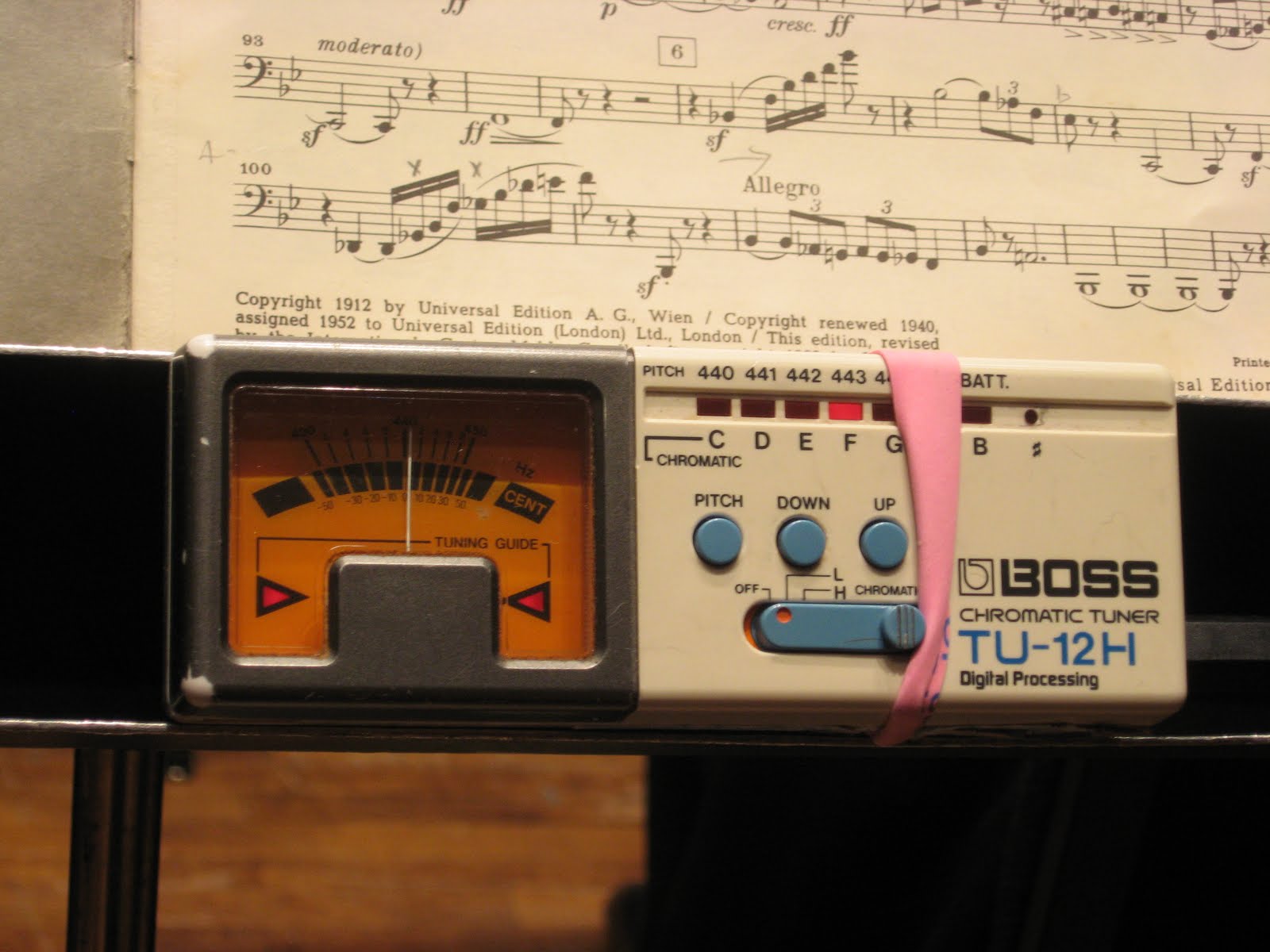
Of course, intonation may be practiced and improved, especially with the use of electronic tuners.  In my last post I mentioned my Boss tuner which I never leave home without.  I use a pickup clipped onto the bocal and plugged into the tuner to enable my pitch to be determined even while the full orchestra is playing:


Because some readers of this blog have asked about the placement of the pickup clip on the bocal, here's a shot of that:


The Boss tuner is invaluable to the bassoonist.  The bassoon has the ability to fool its player into thinking that a note belongs at a pitch which may actually be way off, since some notes resonate best at the wrong pitch.  Furthermore, the tone quality of a note can deceive the player.  For example, low A tends to have a harsh, growling quality on just about any bassoon.  That particular note almost always sounds sharp, even when it actually isn't.  We learn the tendencies of each note on the bassoon, and wanting desperately to do the right thing, we sometimes over-compensate. When I was at Eastman, like many young bassoonists I tended to play on the high side of the pitch.  I was actually pleased when, from time to time, I over-compensated to the point of being flat!  An electronic tuner can certainly help keep us on track so that we actually know when we're over-compensating.  Being overly nervous about the intonation of an uncooperative or unstable note can seriously interfere with our ability to hear accurately.

But tuners are just a tool to be used in practicing.  To prepare us for reliable intonation in a performance situation (when the tuner would be put away) Mr. Van Hoesen taught his students to imagine hearing the correct pitch in our heads before playing a note.  (He wanted us to really listen to that imagined pitch.)  This requires concentration and care, and to this day, when I play a note at a pitch which is less than desirable, it's because I didn't take the trouble to properly hear the note in my head before playing it.  The tuner is a marvelous tool to make sure we're on course, but it is no substitute for the ear. 

Using the Boss tuner to place each note at 440 can be helpful in preparing to perform with piano.  The reason for that is that pianos are tuned according to equal temperament, in which an octave scale is divided into 12 equal intervals.  Each note on a well-tuned piano would register at 440 on a tuner.

Although bassoonists test ourselves against a standard of A=440 in tempered scale (equal temperament), we realistically perform using some tempered tuning (especially when  performing with keyboard instruments) and some  pure or just tuning (generally used by orchestras and choruses).  Just intonation is the development of the scale based on the organic generation of tones as they occur in the natural harmonic series.  Only the tonic registers at 440, and the other notes of the scale slightly deviate from 440.  Musicians tune this way by ear.

Since the meter of the Boss tuner measures in cents, it is quite possible to use the tuner to deviate according to the above adjustments.  But it's a lot easier to do it by ear, because just intonation sounds "right." As an experiment, try playing the 1st 3 notes of a C major scale with your eyes closed.  Be sure that the E is placed where you think it sounds best, and then open your eyes and look at the tuner.  Chances are, the E will be lower than the standard of 440!  The opposite would be true if you played the 1st 3 notes of a c minor scale; in that case, the E flat would be above 440 by 16 cents.

 Pure or just intonation is based on the tonic, which acts as the anchor for the key.  When tuning by ear, each pitch is judged to be in tune if there is an absence of "beats" between itself and the tonic when the two notes are played together.  ("Beats" are the periodic swelling and then dying away of a sound  caused by 2 frequencies going out of phase.)  A sound-producing tuner works well for this test - simply set the tuner to produce a drone of the tonic and play a melody against it, striving to eliminate beats.  The leading tone (7th note of a scale) is controversial because performers may perceive that it needs to be raised, but in fact it is best lowered, according to just tuning.

As Nike says, just do it.

Tuesday, November 17, 2009

Recent adventures

A couple of weeks ago the Columbus Symphony performed the Beethoven Fidelio Overture.  The conductor wisely asked for the chords played by the woodwinds and French horns in the opening Adagios to be played without vibrato. 

Playing without vibrato made it infintely more possible to play the chords in tune, yet it seems to be standard for bassoonists to use vibrato pretty much all of the time. Also, the sound created by the straight tones was pure and simple- very appropriate for this piece. I am now re-thinking the use of vibrato and choosing not to use it some of the time.

I've noticed that on many recordings, the 1st bassoon very often sounds sharp on Bflat3 at the end of the second line in the above excerpt.  Of course, that note is notoriously unstable on just about any bassoon, but I've decided that I'm tired of it!  I'm making it my mission to eliminate the "issues" of that note.  I'll practice long tones (straight- no vibrato!) with the tuner at all dynamic levels until the note is no longer daunting.  I promise to write a report on my progress.  Sometimes, by the way, I add the lower auxiliary key (a.k.a. the low D flat key) to that note to stabilize it, but I consider that to be a crutch and I plan to eliminate that trick after my Bflat3 stabilization project has been completed!  Adding that key changes the resonance of the note, of course.


The Rachmaninov Piano Concerto No. 3 was performed on that same concert.  The above solis from 8 after 33 to 36 provided the perfect demonstration for when to use vibrato and when not to.  The first section is played in octaves with the 1st clarinet, so I used no vibrato.  The 1st oboe takes over the top octaveat 35, so I used vibrato to match him for 8 bars until the clarinet took back the top line, and I switched back to no vibrato.  The conductor had spoken to the orchestra about matching this way.


This passage is from the Dvorak New World Symphony 1st movement.  The 1st clarinet and bassoon play in octaves, but the clarinet plays one extra 16th note before the bassoon enters in each of the 1st 3 bars.  Sometimes I just play with the intention of sticking to my guns and making sure my rhythm is accurate, not worryiing about the clarinet (or perhaps pretending to worry about the clarinet).  Sometimes I listen carefully to the clarinetist, trying to catch his 2nd 16th each time.  This is risky if you haven't ingested enough caffeine.  At any rate, awareness of the clarinet part is critical and as you can see in the above excerpt, I wrote in the rhythm of the clarinet part.  The visual component is very important.  And, I probably don't even need to say that I played this passage without vibrato because it was in octaves with the non-vibrato-producing clarinet.  In the past, I would have played this with a slight vibrato.  It matched the clarinet so much better without any!


This past weekend I subbed for an ailing principal bassoonist in another orchestra.  We performed Beethoven Symphony No. 6, which includes the slow movement soli for clarinet and bassoon pictured above.  Remembering the advice of the previous week's conductor in Columbus, I played this soli with no vibrato with very satisfying results.  Playing this way makes it possible to completely blend with the clarinet, so that it sounds like one intrument.  In the past, I would have played it with minimal vibrato, but why use any?  The clarinet doesn't use any, and shouldn't matching be our primary goal?


Matching the cello section- now that's another story.  Beginning 3 bars after N, the bassoons and celli play a unison soli for 6 bars, and then again in the 16ths in the last 2 lines.  In the hall I was subbing in, I could not hear the cellos at all!  How does a bassoonist match what he/she cannot hear?!  Well, I just make sure I'm in tune (at A=440) and go with the conductor's baton.  It's the conductor's job to be sure the matching occurs.  Since he didn't say anything or show any signs of distress, I have to assume it was OK.  The 2 bassoons also happen to be playing in unison with each other, and the 2nd bassoonist, whom I had never met before, graciously rehearsed these soli with me during intermission.


I never leave home without my Boss TU-12H electronic tuner with guitar pickup which attaches to the bocal.  This enables the tuner to pick up myn pitch even while the entire orchestra is playing.  I've been known to play entire rehearsals "plugged in."  I don't apologize for it, either, because the bassoon is a tough instrument to play in tune.  Oftentimes, the bassoon fools the player into thinking that a note sounds right at the wrong pitch because it resonates better at that pitch!


Most bassoonists will recognize the above solo from the 1st moevemnt of Beethoven 6.  It's deceivingly tricky.  Since we played in a hall unfamiliar to me, I didn't know whether I'd be able to listen to the violins echoing my eighth notes in the first and second measures, or whether I'd have to focus on following the conductor's baton, ignoring what I heard.  I tried to look at the baton, but I realized in the final performance that I was also playing by ear.  In the Ohio Theatre, that would have been a big mistake- I would have ended up being behind because of the delay in the sound.  But since the conductor wasn't grimacing or scowling, I'll have to assume that what I was doing was working in that hall.


I think that the above excerpt from Mahler 9, which the Columbus Symphony performs this week, could be used as the repertoire for a bassoon audition.  It has everything- high, low, loud, soft, obnoxious, delicate, short, long, unison lines with horns, exposed solos, accents, slurs, you name it!  Mahler really knew how to push us past our limits, yet, ironically, a Mahler Symphony is rarely seen on a bassoon audition list.


This solo, which starts at the end of the first line above, crescendos up to a high C#4.  However, it becomes all about the trumpet from C#4 to the end of the solo.  The loudest intrument always wins, and the bassoon is never the loudest!  We have no choice but to match the intonation of the loudest instrument, which oftentimes in Mahler is one of the French horns, or in this case, the trumpet.


Why are we bassoonists so incredibly daunted by low pitched solos like this one in the Adagio of Mahler 9?  This solo reminds me of the dreaded opening of Tchaikowsky Symphony No. 6 (which we're also performing this season!).  I guess the problem is that the chances of equipment malfunction is so much greater in the lower extremities of the instrument.  I start sweating blood just thinking about the likleihood of my reed responding reliably!  And I spent all day yesterday trying to make the perfect reed for that solo.  To me, this solo calls for a reed switch.  I prefer to play a concert on one reed, but certain solos demand a special reed which favors the notes in the solo.  For me, old reeds are best for low playing, although I generally avoid old reeds.  We haven't rehearsed this movement yet, so my success on this passage remains to be heard.  Wish me luck!

Sunday, November 1, 2009

Halloween bassoon excerpts


Last night the Columbus Symphony performed a Halloween Pops concert under the direction of Albert-George Schram. Here's a review of the concert:
Music Review | Columbus Symphony: Pops season begins on Halloween high note

I was surprised to discover that the Halloween repertoire features so many challenges for the bassoon.  It would be possible to hold a principal bassoon audition based upon Halloween repertoire alone!

For tonguing, there is no greater test than "Sleigh-Ride" from The Devil and Daniel Webster by Bernard Herrmann.  Take a look:


Here's a closer look:

The tempo requires this passage to be double-tongued, and of course, double-tonguing is quite difficult in the lower range of the bassoon.  Low range double-tonguing varies greatly from reed to reed, and I was fortunate to find a reed that cooperated.  I still had to practice it, though, using my usual approach of first perfecting it all slurred and then adding the tonguing.  I kept my fingers very close to the holes for this passage, which is a technique promoted by my teacher K. David Van Hoesen.

I had never heard this intriguing little piece before.  It has an eerie quality to it, making it a wise choice for Halloween.  I'm glad to have another tongue-twister under my belt.

A more familiar number on this program was the Saint-Saens Danse Macabre, a Halloween staple.

At letter A, the bassoon and oboe play the melody in octaves.  This solo can be a finger twister.  I like to practice it at a range of tempos so that I'm ready for anything, and so that I'm capable of moving it if I have to.  When practicing a passage like this in which the fingers can become entangled, I focus on complete relaxation above all.  As soon as tension sets in, the fingers seize up.  This type of passage is another example of one which I practice all slurred, to ensure that the fingers are moving with total evenness.

Here's another Halloween piece which was new to me:

The solo starting in measure 21 is awkward at the fast cut-time tempo.  For odd passages like this, the best solution seems to be familiarity.  I went over it slowly many times to make it automatic, focusing on being relaxed at all times.  As soon as tension creeps in, the accuracy diminishes.

Mussorgsky's A Night on Bald Mountain is another Halloween favorite.  Two of its tricky passages appear on this page:

At the top of the page, the bassoon joins the oboe in octaves to provide the melody.  If your fingers are secure, you have the freedom to employ a bit of rubato and push ahead on the eighths.  For me, the coordination between tongue and fingers is best ensured by first practicing the passage all slurred. (I know- I keep saying this!)

Five measures after F, the 1st clarinet and 1st bassoon start an accelerando.  Once again, if your technique is secure, alteration brought about by either rubato or tempo change is no problem.  I always try to prepare passages to such a level which allows for such flexibility.  You never know what's going to happen in the orchestra.....

I'm sure there's a bassoon audition list appropriate for each holiday- in fact, I'm already envisioning a Christmas audition list.  The Tchaikowsky Nutcracker Ballet (the complete ballet, not the suite) provides plenty of fodder for a bassoon audition- add to that the Resphighi Adoration of the Magi, and every imagineable aspect of bassoon playing is covered!

Thursday, October 29, 2009

Practicing on a day off

A day off from symphony services does not mean that I also have a day off from the bassoon!  That's because of the embouchure. (The embouchure is the use of facial muscles and the shaping of the lips around the reed or mouthpiece of a wind instrument. The word is of French origin and is related to the root bouche,"mouth.")  The embouchure has to be carefully maintained- even one day of not playing makes a noticeable difference.  Like any other set of muscles in the body, the muscles associated with embouchure can be either well-exercised and strong, or ignored and atrophied.  I don't like to lose control of my embouchure.  If its muscles are weak, I lose control- my embouchure just gives out after a certain amount of playing.  I don't know how that phenomenon presents itself on other instruments, but on the bassoon, it means that intonation goes out the window.  Tone quality suffers as well.

Thus, a day off from symphony services means that I still practice.  Usually there is a program on the horizon for which I'll start preparing, but my favorite day off practicing is done without any printed music.  This is especially valuable now, because I'm getting used to a new bassoon.  I usually start with some sort of scale work, extended to cover the entire range of the bassoon, focused on intonation, tone quality, and smoothness.  Also, scales are great for overcoming the natural tendency of the bassoon to decrescend as the the scale rises (opposite of other instruments).

I like to turn my chair so that I am able to look out the window during scales- I want the scales to be automatic, and the distraction of looking out the window helps with that.  This doesn't mean that I stop listening, though- the same as with regular practicing, if there is a lack of smoothness in any transition from one note to the next, it's necessary to stop, isolate the problem and iron it out.  The same applies to intonation.  My bassoon is brand new, and it will take a very long time (years!) to break in.  It's constantly changing.  The amount of embouchure and air pressure which caused a note to play in tune last week might be different this week!

I practice more in the extreme high range than in any other part of the instrument.  Sometimes I'll practice scales in the extreme high range only.  The reason I do this is because we bassoonists are seldom called upon to play in the high extremities, and therefore we don't spend much time up there.  Then, when we are called upon play up there, it's hit or miss- the notes may or may not come out, and when they do, they may not be in tune, and transitioning from note to note is awkward.  The obvious solution is to spend lots of time practicing up there so that the high range is familiar!

After scale work, I move on to vibrato.  Lately I have been using an exercise which I remember hearing  my flutist friends practicing at Eastman. I think they said it was an exercise developed by the famous flute master Marcel Moyse- it involves long tones, with vibrato, two notes at a time.  The first note is a half step higher than the second, and the phrase of 2 notes begins pp, senza vibrato, with a big crescendo, vibrato increasing, as the first note transitions into the second, and the 2 note phrase ends with a decrescendo to nothing.  I like the challenge of making my vibrato sound like a flutist's vibrato, with clarity and varying intensity.  This exercise is a great embouchure builder.  Sometimes at the end of this exercise, I play improvised melodies, paying close attention to the vibrato.  Usually I then add a few phrases from upcoming concerts- there are always certain intervals or exposed passages to work on obsessively!  Still, I keep my policy of no music- even the detailed work on upcoming symphony music has to be from memory.

My day off practicing routine not only maintains embouchure- it promotes familiarity with the instrument.  Do you ever feel "out of touch" with your instrument, when you have trouble "placing" notes at their correct pitches?  I have noticed that sometimes I feel out of touch with the instrument as a whole when I have had to spend a disproportionate amount of time focused on one specific program.  I can be playing each passage in that program at an acceptable level, but my global familiarity with the instrument can still be off!  There are days when I choose not to practice, so that my embouchure remains fresh for rehearsals or concerts in that same day.  I think that orchestral players can easily fall into the trap of becoming narrowly focused on only the material being performed.  The solution to that problem is the "familiarity" practicing which I am describing here-even if you can't do it every day due to embouchure-saving for rehearsals and concerts.

I often conclude these "familiarity" (or "embouchure building") practice sessions with a movement of a Bach cello suite or an etude of some sort (with printed music!).  It's so valuable to play extensive pieces like this instead of just narrowing the focus onto a few brief exposed passages of orchestral literature.  It's fine (and necessary) to practice and prepare the orchestral music, but there's so much more business to attend to if one's goal is to master an instrument!